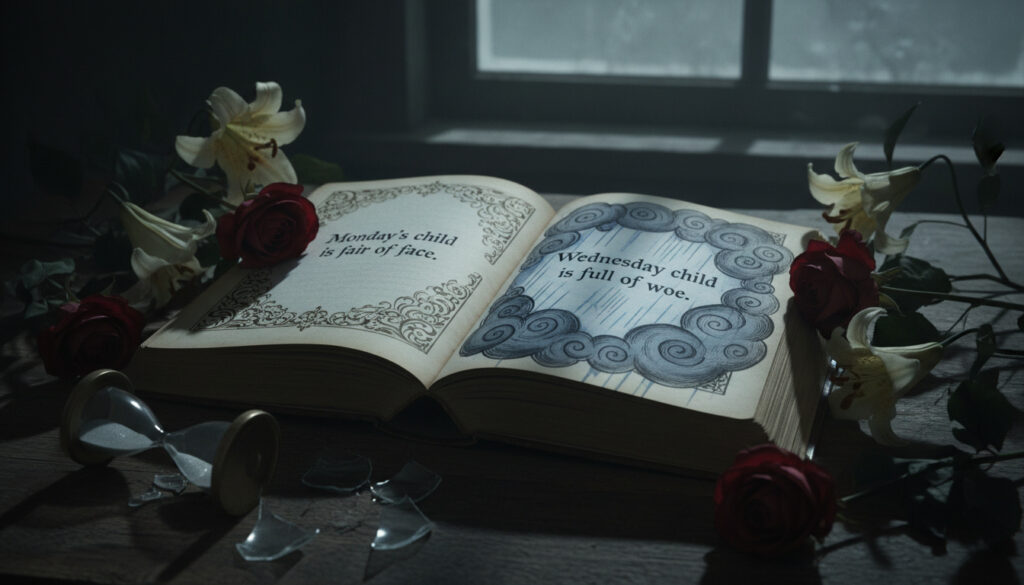
Wednesday’s Child Is Full of Woe – Meaning, Origin, Full Rhyme
The line “Wednesday’s child is full of woe” has echoed through English-speaking childhoods for generations, a stark prediction amid an otherwise playful nursery rhyme. Part of the traditional “Monday’s Child” verse, this phrase assigns melancholy fortunes to those born midweek, continuing a centuries-old tradition of birth-day fortune-telling folklore. Despite its enduring presence in popular culture, the rhyme represents fanciful poetic invention rather than empirical fact, serving primarily as a mnemonic device for teaching days of the week.
This traditional English nursery rhyme pairs each day with specific personality traits, creating a weekly calendar of predicted temperaments. While Monday brings fairness of face and Tuesday offers grace, Wednesday bears the burden of sorrow—a distinction that has fascinated parents, writers, and folklorists since the verse first appeared in print during the 1830s.
The cultural impact of this simple rhyme extends beyond the playground. Charles Addams famously named his morbid daughter character Wednesday Addams after the verse, cementing the association between Wednesday-born children and gloom in popular imagination. Yet the origins and veracity of these predictions remain rooted in Victorian literary tradition rather than biological reality.
What Does ‘Wednesday’s Child is Full of Woe’ Mean?
Forecasts sorrow or misery for Wednesday-born individuals
16th-century English fortune-telling tradition
Inspired character names like Wednesday Addams
Teaching mnemonic for days of the week
- The phrase represents one of seven daily predictions in the Monday’s Child rhyme cycle
- Wednesday remains the only day explicitly associated with negative emotions in most versions
- The verse functions as both entertainment and pedagogical tool for children learning weekdays
- Anna Eliza Bray’s 1838 collection established the standard text still recited today
- No scientific correlation exists between birth day and personality traits
- The Roud Folk Song Index catalogs this as entry #19526
- Variants occasionally shift “woe” to Friday, reflecting evolving superstitions
| Day | Trait | Interpretation |
|---|---|---|
| Monday | Fair of face | Attractive, charming, healthy appearance |
| Tuesday | Full of grace | Elegant, poised, refined manner |
| Wednesday | Full of woe | Melancholy, sorrowful disposition |
| Thursday | Has far to go | Adventurous spirit or significant life journey |
| Friday | Loving and giving | Generous, affectionate nature |
| Saturday | Works hard for a living | Diligent, laborious work ethic |
| Sunday | Bonny and blithe | Cheerful, attractive, fortunate |
What Is the Full ‘Monday’s Child’ Nursery Rhyme?
The Standard 1838 Text
The version most commonly recited today derives from Anna Eliza Bray’s Traditions of Devonshire, published in 1838. This arrangement established the sequential pattern of attributions that would define the rhyme for subsequent generations. Wikipedia’s entry on Monday’s Child notes that this printing represents the earliest complete text of the modern version.
The full verse reads:
Monday’s child is fair of face,
Tuesday’s child is full of grace,
Wednesday’s child is full of woe,
Thursday’s child has far to go,
Friday’s child is loving and giving,
Saturday’s child works hard for a living,
And the child born on the Sabbath day
Is bonny and blithe, and good and gay.
Regional and Historical Variations
Oral tradition has produced numerous textual variants across different English-speaking regions. All Nursery Rhymes documents several significant deviations from Bray’s standard text, including versions that substitute “Christmas Day” for Sunday, reflecting the holiday’s religious significance in certain communities.
An 1887 printing in Harper’s Weekly notably transposed several attributes, assigning “full of woe” to Friday rather than Wednesday—possibly connecting the sorrow to Good Friday and the Crucifixion. This version also swapped Thursday and Saturday’s characteristics and described Sunday’s child as “happy and wise” rather than “bonny and blithe.” Modern parenting resources continue to catalog these differences for families exploring the rhyme’s variations.
Beyond fortune-telling, the rhyme serves as an effective mnemonic device for children learning the sequence of weekdays, similar to the How Many Eyes Does a Spider Have – From 8 to Zero Explained approach to biological facts—making complex information memorable through verse.
Where Does the ‘Monday’s Child’ Nursery Rhyme Come From?
Ancient Fortune-Telling Roots
The tradition of predicting personality based on birth days extends deep into English folklore. Literary historians trace the concept to the 1570s, when writer Thomas Nashe documented Suffolk folktales that connected specific days with particular fortunes. These early versions focused primarily on predicting luck and prosperity rather than the detailed character attributes found in the Victorian rhyme.
The practice reflects broader European traditions of hemerology—the study of lucky and unlucky days—that influenced folk customs for centuries. Parents and midwives once consulted such rhymes to determine propitious dates for baptisms or to forecast a child’s prospects, though these beliefs remained distinct from the astrological traditions that assigned zodiac signs based on birth months.
Victorian Documentation
While oral variants certainly circulated earlier, the rhyme achieved fixed literary form when Anna Eliza Bray published her collection of Devonshire traditions between 1836 and 1838. This two-volume work preserved regional folklore at a moment when industrialization threatened traditional rural customs. James Orchard Halliwell later included modified versions in his Nursery Rhymes and Fairy Tales during the 1840s, introducing the “Christmas Day” variant that appealed to religious households.
Is There Any Truth to the ‘Monday’s Child’ Poem?
Scientific Examination
Empirical investigation has found no correlation between birth day of the week and subsequent personality development. Literary analysts characterize the rhyme as “purely fanciful,” noting that the attributes assigned to each day follow poetic convenience rather than psychological observation. The predictions represent a form of aphoristic folk wisdom rather than testable hypothesis.
A study examining the phenomenon identified confirmation bias as the primary mechanism sustaining belief in the rhyme’s predictions. Researchers observed that individuals aware of the rhyme tend to notice and remember instances that confirm their assigned trait while dismissing contradictory evidence. Parental influence may also reinforce perceived traits—parents expecting “graceful” Tuesday-born children might encourage dance lessons, creating self-fulfilling prophecies unrelated to the actual day of birth.
The rhyme shares structural similarities with astrological predictions but lacks even the astronomical basis of zodiac traditions. It functions purely as cultural entertainment and educational verse.
While whimsical, associating specific days with negative traits like “woe” could potentially influence parental expectations or children’s self-perceptions. Modern interpretations should emphasize the rhyme’s historical and literary value rather than predictive authority.
How Has the Monday’s Child Rhyme Evolved Over Time?
- — Thomas Nashe documents Suffolk folktales linking birth days to fortunes, establishing early precedent for the tradition
- — Anna Eliza Bray publishes the first printed version in Traditions of Devonshire, creating the standard text
- — James Orchard Halliwell introduces variant substituting “Christmas Day” for Sunday in his nursery rhyme collections
- — Harper’s Weekly publishes version with transposed traits, moving “woe” to Friday and altering weekend descriptions
- — The rhyme enters the Roud Folk Song Index as #19526 and becomes standardized in educational materials worldwide
What Do We Know for Certain About Birth Day Predictions?
| Established Information | Information That Remains Unclear |
|---|---|
| First printed in Bray’s 1836-1838 collection | Specific pre-1830s oral tradition origins |
| Derives from 16th-century English folklore | Why Wednesday specifically was chosen for “woe” |
| No scientific validity or correlation | Whether regional variants reflect local superstitions or transmission errors |
| Multiple documented variations exist | The exact mechanism of how oral traditions stabilized into the 1838 version |
What Is the Cultural Significance of the Days of the Week Poem?
The Monday’s Child rhyme occupies a unique position at the intersection of entertainment and education. Victorian collectors like Bray sought to preserve rural traditions that rapid industrialization threatened to erase, inadvertently creating a standardized text from fluid oral traditions. The rhyme thus serves as a literary fossil, preserving 19th-century attitudes toward fate, character, and the passage of time.
In contemporary contexts, the verse continues to function as a playful framework for understanding temporal sequences. Parents and educators use the rhythmic structure to help young children master the order of weekdays, while literary scholars examine its reflection of historical attitudes toward childhood and destiny. The rhyme’s survival into the digital age demonstrates the enduring appeal of simple, sequential learning tools.
What Do Primary Sources Reveal About the Rhyme?
“Monday’s child is fair of face… And the child born on the Sabbath day is bonny and blithe, and good and gay.”
Primary archival records confirm that Bray recorded the rhyme from oral tradition in Devon, suggesting the version she published reflected actual regional practice rather than literary invention. The consistency of the “full of woe” line across multiple 19th-century sources indicates this attribution for Wednesday was already well-established in English folklore before standardization, though the specific reasoning behind this association remains speculative.
What Is the Legacy of Wednesday’s Child?
The phrase “Wednesday’s child is full of woe” endures as a cultural shorthand for melancholy temperament, transcending its origins as a simple teaching rhyme. While modern understanding acknowledges the verse as fanciful folklore without predictive power, it retains value as a historical artifact of Victorian England and a functional mnemonic for early education. For families seeking Things to Do with Kids – Free Indoor and Outdoor Ideas, exploring traditional rhymes offers both entertainment and insight into historical childhood experiences.
Frequently Asked Questions
What are variations of the days of the week nursery rhyme?
Notable variants include substituting “Christmas Day” for Sunday, shifting “full of woe” to Friday (1887), and altering “bonny and blithe” to “happy and wise.” Some versions use gendered language like “his living” for Saturday’s child.
What does “full of woe” specifically mean?
The phrase predicts a melancholy, sorrowful, or miserable disposition. In historical context, “woe” signified deep grief or misfortune, though modern interpretations often treat it as gentle whimsy rather than serious prediction.
Who wrote the Monday’s child rhyme?
No single author is known. Anna Eliza Bray first printed the standard version in 1838, but the rhyme emerged from anonymous oral traditions dating to at least the 1570s.
Is Wednesday’s child always unlucky?
The rhyme suggests a predisposition to sorrow, but this is folk poetry, not fact. Modern understanding recognizes no correlation between Wednesday births and negative outcomes.
How does the rhyme help children learn?
The rhythmic, alliterative structure creates a memorable framework for sequencing weekdays. Children associate each day with distinctive imagery, reinforcing temporal concepts through poetry.
What does “bonny and blithe” mean?
“Bonny” means attractive or healthy-looking; “blithe” means cheerful, carefree, or lighthearted. Together they describe a fortunate, joyful disposition assigned to Sunday-born children.
Are there scientific studies on birth day personality?
Studies have found no evidence supporting birth day-personality correlations. Observed matches typically result from confirmation bias and parental influence rather than actual connections.
More related posts
 How Many Words Is This? Count Words in Any Document
 Admiral Phone Number 0333 0800 Opening Times Guide
 Find an Obituary for a Specific Person UK: Free Search
 Let the Right One In: LGBT Themes, Cast & Analysis Explained
 A to Z Horses Running Today: Complete Guide & Free Tips
 Free Museums in London – Top Picks and Hidden Gems
 Cast of The Crown: Full Cast List by Season 1-6
 Brian Harvey: East 17 Singer’s Net Worth, Royalties & More