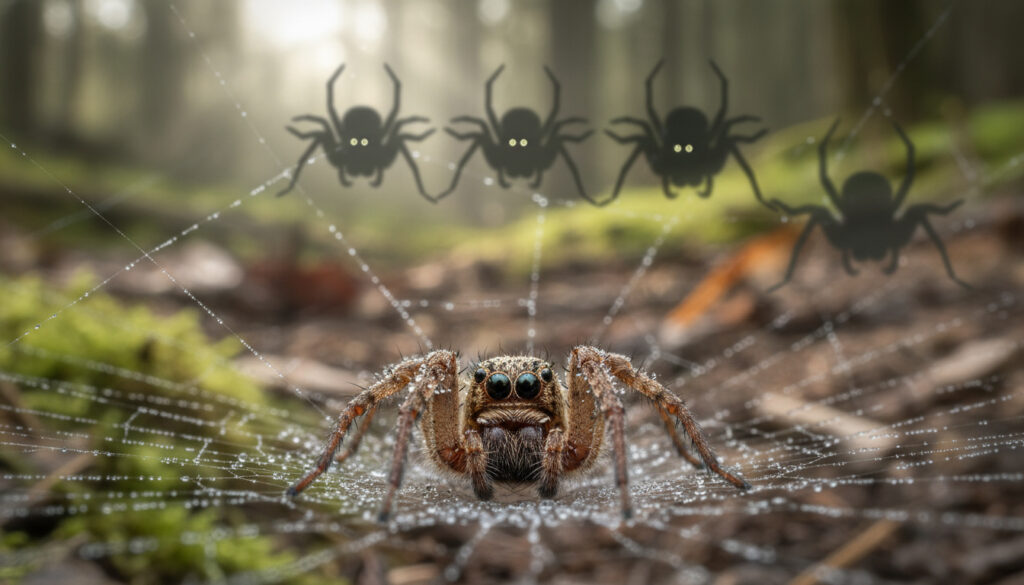
How Many Eyes Does a Spider Have – From 8 to Zero Explained
Most spiders possess eight simple eyes arranged in two rows on the cephalothorax, though this number varies significantly across the order Araneae. Unlike insects with their compound eyes, spiders bear simple eyes known as ocelli, each containing a single lens that captures light differently depending on the eye’s position and structure.
Researchers classify these arachnids by eye count and arrangement, features that serve as critical diagnostic tools for identification. While the eight-eyed configuration dominates the order, evolutionary adaptations have produced species with six, four, two, or even no eyes, each modification reflecting specific environmental pressures and hunting strategies.
How Many Eyes Does a Spider Have?
| Fact | Details | Examples | Sources |
|---|---|---|---|
| Typical Count | 8 eyes arranged in two rows of four | Wolf spiders, orbweavers, garden spiders | Wikipedia |
| Variations | 6, 4, 2, or 0 eyes | Recluse spiders (6), cave dwellers (0) | Wikipedia |
| Eye Types | Simple ocelli with principal/secondary distinction | All spider families | Britannica |
| Vision Quality | Motion detection; poor acuity except specialists | Jumping spiders (high acuity) | Vision Research |
- Eight is standard: The vast majority of spider species possess eight simple eyes arranged in two rows.
- Not compound: Unlike insects, spider eyes are ocelli with single lenses, not compound structures.
- Two functional classes: Principal (anterior median) and secondary (lateral and posterior) eyes serve different visual purposes.
- Taxonomic markers: Eye arrangement identifies family and sometimes genus, but rarely distinguishes species.
- Six-eyed exceptions: When spiders have six eyes, the absent pair is always the principal eyes.
- Vision varies: Most detect motion poorly, while jumping spiders possess acute telephoto-like vision.
- Tapetum presence: Secondary eyes typically contain light-reflecting guanine crystals for night vision.
| Feature | Typical Configuration | Exceptions | Primary Function |
|---|---|---|---|
| Eye Count | 8 | 6, 4, 2, 0 | Visual detection |
| Eye Structure | Simple (ocelli) | None known | Light capture |
| Principal Eyes | 2 (Anterior Median) | Absent in some species | Acute vision |
| Secondary Eyes | 6 (ALE, PME, PLE) | Reduced numbers | Motion detection |
| Retina Type | Everted (principal) Inverted (secondary) |
None | Image processing |
| Tapetum | Present in secondary | Absent in jumping spiders | Light reflection |
| Field of View | ~360° combined | Varies by family | Predator detection |
| Focus Mechanism | Fixed lens | Movable internal lenses | Image clarity |
Do All Spiders Have 8 Eyes?
No. While eight eyes constitute the ancestral condition for spiders, numerous families contain species with reduced eye counts. Six-eyed spiders represent the most common variation, occurring in families such as Sicariidae (recluse spiders) and some caponiids.
In six-eyed species, the absent pair is consistently the anterior median eyes—the principal eyes responsible for acute vision in eight-eyed species. This reduction correlates with hunting strategies relying less on visual acuity and more on mechanical vibrations or chemical sensing.
Eye reduction follows specific evolutionary patterns. When spiders lose eyes, they always lose the principal pair first, followed by secondary eyes in a predictable sequence based on their position.
Four-Eyed and Two-Eyed Species
Four-eyed spiders appear in some Caponiidae, while two-eyed species exist in specialized cave environments. These extreme reductions typically occur in permanent darkness where visual input provides no selective advantage.
Eyeless Arachnids
A few troglobitic (cave-dwelling) species have completely lost their eyes, diverting metabolic resources to other sensory structures like elongated legs and enhanced mechanoreceptors.
Why Do Spiders Have So Many Eyes?
Multiple eyes provide spiders with nearly panoramic vision without head movement. The secondary eyes—positioned laterally and posteriorly—detect motion across approximately 360 degrees, crucial for spotting predators and prey. Meanwhile, the principal eyes face forward, providing stereoscopic vision for depth perception during hunting.
This division of labor allows simultaneous wide-field surveillance and focused attention. Secondary eyes contain a tapetum, a guanine-crystal layer that reflects light through the retina, effectively doubling sensitivity in low-light conditions. Principal eyes lack this structure but offer higher resolution for precise tasks.
The Motion Detection Advantage
Secondary eyes specialize in detecting movement rather than form. When these eyes spot potential prey, the spider orientates its body to bring the principal eyes into alignment, switching from surveillance to targeting mode.
How Do Spiders See With Their Eyes?
Spider vision depends on eye type. Principal eyes (AME) provide sharp images but require more light, functioning like telephoto lenses. Secondary eyes (ALE, PME, PLE) act as wide-angle motion detectors with lower resolution but higher light sensitivity.
Jumping spiders (Salticidae) possess the most sophisticated visual system. Their principal eyes contain a telephoto-type lens system with multiple internal lenses that move back and forth within the fixed external lens. Several muscles control this focusing mechanism, allowing the spider to track objects at varying distances despite immobile eyeballs. When observing their surroundings, jumping spiders turn their heads side to side to compensate for fixed lenses.
Jumping spider eyes function similarly to Galilean telescopes, with a concave internal lens moving within a convex external lens to achieve variable focus—a biomechanical solution evolved independently of human optical technology.
Tapetum Variations
Spider families display three distinct tapetum architectures. The primitive-type fills the entire eye cup, found in Mesothelae and Mygalomorphs. Canoe-type tapeta feature two walls separated by a median nerve gap, characteristic of Theridiidae and Clubionidae. Grate-type tapeta appear in other families, though specific characteristics remain under study.
Most spiders cannot see detailed images beyond a few centimeters. Their secondary eyes detect only movement and light levels, making them functionally “blind” to stationary objects beyond immediate proximity.
Compound Eye Misconceptions
Unlike insects, spiders never possess compound eyes. Each eye is a simple ocellus with a single cuticular lens, concave retina, and cellular vitreous body containing rhabdomeres—the light-sensitive structures.
Evolutionary Timeline of Spider Vision
- : Early arachnids develop simple ocelli from ancestral photoreceptor patches.
- : Emergence of the eight-eyed arrangement becomes dominant in terrestrial spiders.
- : Specialization of principal versus secondary eyes establishes distinct visual pathways.
- : Jumping spiders evolve advanced lens systems with internal focusing mechanisms.
- : Cave-dwelling species begin losing eyes through regressive evolution.
- : Over 48,000 species display eye counts ranging from zero to eight, with arrangement patterns serving as primary taxonomic identifiers.
Established Facts and Persistent Questions
| Established Information | Information Remaining Unclear |
|---|---|
| 99% of spiders have eight or fewer eyes | Exact spectral sensitivity ranges for most species |
| Six-eyed species always lack principal eyes | Complete neural processing pathways for vision |
| Jumping spiders possess the most acute vision | Evolutionary triggers for eye loss in specific lineages |
| Eye arrangement identifies family-level taxonomy | Species-specific vision capabilities in low-light conditions |
| No spiders possess more than eight eyes | Full extent of color vision across different families |
Taxonomic Significance
Eye arrangement serves as one of the primary diagnostic features in arachnology, distinguishing families such as Lycosidae (wolf spiders), Salticidae (jumping spiders), and Araneidae (orb-weavers). Different families exhibit characteristic patterns—wolf spiders display three rows with large posterior eyes, while jumping spiders possess two enormous anterior median eyes dominating their cephalothorax.
However, eye arrangement can identify spiders to family and sometimes to genus, but is almost never useful for species-level identification. Within genera, eye patterns remain relatively consistent, while family-level distinctions prove reliable enough for field identification by experienced naturalists. This limitation necessitates additional characteristics such as genital morphology for precise species determination.
Understanding these anatomical features proves valuable across biological disciplines, much like analyzing House for Sale Leicester – Prices Areas and Trends requires attention to specific localized details.
Expert Perspectives
The eye arrangement of spiders is a primary diagnostic feature for identification and classification of different species, genera, and families.
— Arachnology Research, Spider Vision Studies
Jumping spiders possess remarkably acute vision compared to most other spiders, utilizing a sophisticated telephoto-type lens system.
— Vision Research, Comparative Arachnid Optics
Key Takeaways
Spiders typically possess eight simple eyes arranged in two rows, though variations ranging from six to zero eyes occur across different families and ecological niches. These ocelli divide into principal and secondary types, creating a dual-purpose visual system that balances motion detection with focused acuity. While most spiders rely on secondary eyes for detecting movement across wide fields, specialized hunters like Who Is Brandi Carlile – Grammy Winner Biography Career Family demonstrate how specialized adaptations can evolve in complex biological systems, similar to the sophisticated visual mechanisms in jumping spiders.
Frequently Asked Questions
Can spiders see color?
Research indicates some spiders, particularly jumping spiders, possess color vision through specialized receptors in their principal eyes, though most species perceive limited color ranges or rely on motion detection rather than chromatic distinction.
Do spiders have good eyesight?
Vision quality varies dramatically by species. Jumping spiders exhibit excellent acuity capable of resolving details at centimeters to meters, while most web-building spiders have poor eyesight limited to detecting light changes and nearby motion.
Are spider eyes compound like insects?
No. Spiders possess simple eyes (ocelli) with single lenses, unlike insects with compound eyes containing thousands of ommatidia. Each spider eye functions as an independent camera-type optical system.
What can spiders see with their eyes?
Secondary eyes detect movement and light intensity across wide fields, while principal eyes provide focused vision for depth perception and detail recognition in frontal regions. Jumping spiders can track prey and mates visually across significant distances.
How many eyes do different spiders have?
Most have eight, but recluse spiders have six, some caponiids have four or two, and certain cave species have none. The count correlates with hunting strategy—active hunters tend toward eight eyes with good vision, while ambush predators may have fewer.
Can spiders see in the dark?
Many spiders possess a tapetum in secondary eyes—a reflective layer that doubles light sensitivity, enhancing night vision. However, they cannot see in complete darkness and rely on other senses when light levels drop below threshold.
More related posts
 England Kick-Off Time 2025-2026: Full Guide to Matches on TV
 Pharmacy First Near Me: Services & Walk-In Access
 Roblox Grow a Garden: Gameplay, Safety & Parent Guide
 BA Manage My Booking: How to Access, Seat Selection & App Guide
 How Many Words Is This? Count Words in Any Document
 Chicken Chow Mein Recipe – Authentic Easy 30-Minute Guide
 Hey Dudes: FTC Settlement, Podiatrist Warnings, Foot Health
 Delhi Capitals vs Gujarat Titans: Scorecard, Highlights & Result