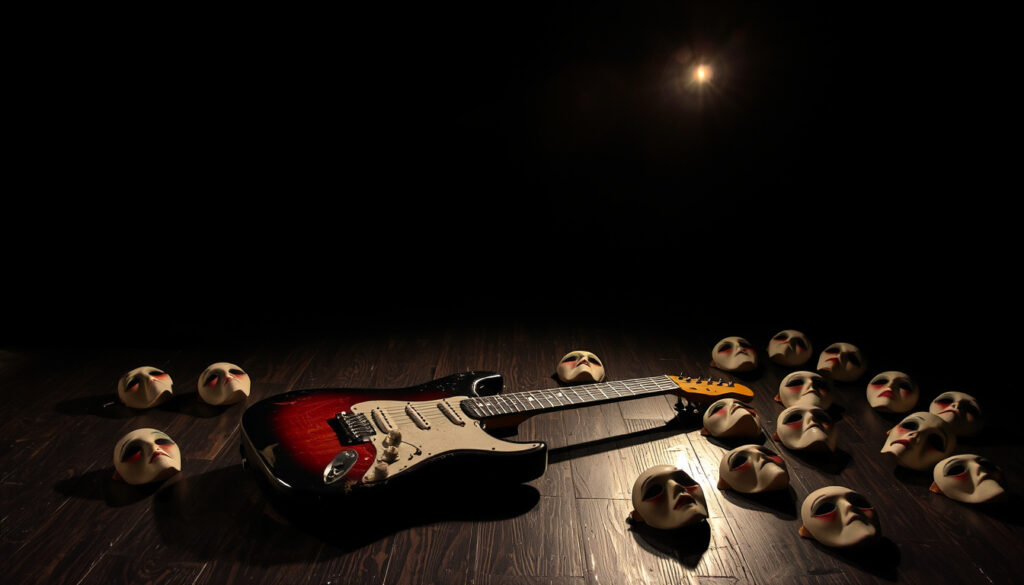
Wes Borland: Masks, Guitar, and Why He Left Limp Bizkit
Few guitarists have turned discomfort into a signature the way Wes Borland has. For over two decades, his masks, off-kilter riffs, and multiple exits from Limp Bizkit have made him the band’s most fascinating wildcard — the quiet force who keeps walking away, then walking back in.
Years active: 1995–present ·
Studio albums with Limp Bizkit: 6 ·
Best-selling Limp Bizkit album: Significant Other (7 million copies) ·
Signature guitar model: Jackson JS32T Wes Borland
Quick snapshot
- Wes Borland joined Limp Bizkit in 1995 and has left and rejoined multiple times (MusicRadar guitar magazine).
- He wears masks to create a stage character separate from his private life (The Believer literary magazine).
- Exact personal reasons behind his departures beyond stated creative differences.
- His long-term plans after Limp Bizkit’s 2026 tour.
- Borland’s pattern: leaves in 2001, returns 2004, leaves again 2011, rejoins 2018 (MusicRadar guitar magazine).
- 2026 tour announced, suggesting continued commitment. (MusicRadar guitar magazine)
- Limp Bizkit has announced 2026 tour dates. (The Believer literary magazine)
- Borland continues side projects, including Black Light Burns (The Believer literary magazine).
Key facts: Wes Borland
| Label | Value |
|---|---|
| Full name | Wesley Louden Borland |
| Born | February 7, 1975 |
| Band | Limp Bizkit |
| Instruments | Guitar, vocals, bass |
| Years active | 1995–present |
| Signature guitar | Jackson JS32T Wes Borland |
| Side projects | Black Light Burns, Marilyn Manson (live) |
| Best-selling album | Significant Other (7 million copies) |
Why Did Wes Borland Leave Limp Bizkit?
Wes Borland’s exits from Limp Bizkit are as notorious as his face paint. He left for the first major time in 2001, shortly after the band’s biggest album cycle. In a 2011 interview with MusicRadar guitar magazine, Borland explained he wanted to break out of the “set sound” Limp Bizkit had locked into — he felt the music had become boring and continuing would have been about money, not creativity (Blabbermouth metal news site).
What was the reason for his departure?
- Creative differences with Fred Durst’s leadership style.
- Discomfort with the band’s mainstream fame and image (RTÉ Irish public broadcaster).
- Personal financial trouble: Borland lost over a million dollars in the stock market around 9/11 (MetalSucks metal blog).
- The death of a fan during Limp Bizkit’s Big Day Out set in 2001 also affected him deeply (Grunge pop culture site).
Did he return to the band?
Yes — multiple times. He returned for the 2004 album The Unquestionable Truth (Part 1), left again in 2011 after Gold Cobra, and rejoined in 2018 for touring and new music (Grunge pop culture site). A 2002 interview with RTÉ Irish public broadcaster confirmed the split was amicable at the time, though Borland hadn’t spoken to the other members.
How Good of a Guitarist Is Wes Borland?
Borland is rarely mentioned in “best guitarist” lists, but his impact on nu-metal riff writing is distinctive. He uses extended-range guitars, odd time signatures, and heavy downtuning — a sound that sets Limp Bizkit apart from peers like Korn.
What is Wes Borland’s signature guitar model?
His primary signature model is the Jackson JS32T Wes Borland, a budget-friendly variant of the Jackson King V shape. The guitar features a mahogany body, maple neck, and a pair of Jackson high-output humbuckers. Borland’s original King V was reportedly a custom-shop reject he bought cheap (Jackson Guitars blog).
What is unique about his playing style?
- Frequent use of drop tunings (drop A# on seven-string guitars).
- Heavy reliance on palm-muted, syncopated riffs.
- Incorporation of electronic textures and samples during live shows.
- He also plays keyboards, cello, and sings in his side project Black Light Burns (The Believer literary magazine).
Borland’s willingness to experiment with tuning and extended-range guitars gave Limp Bizkit a sonic identity that was heavier and more textured than the typical rap-rock of the era. His riffs are instantly recognizable — and that’s rare for a band often dismissed as a joke.
The implication: Borland’s technical choices transformed what could have been generic rap-rock into something sonically distinct, even if critics overlook that contribution.
Why Does Wes Borland Always Wear a Mask?
Borland’s masks have become as iconic as his guitar. In a micro-interview with The Believer literary magazine, he said: “It’s like a shield. I can be someone else on stage.” The mask allows him to separate his private life from a theatrical stage persona.
What is the meaning behind Wes Borland’s mask?
- Creates a character that can act out emotions without self-consciousness.
- Helps him focus on performance rather than his appearance.
- Evolves with each album; for Chocolate Starfish he wore a full-head latex mask, later simpler face paint.
“It’s like a shield. I can be someone else on stage.”
— Wes Borland, The Believer literary magazine
The mask is not just decoration — it’s a psychological tool that enables the performance. Without it, Borland has said he feels exposed and unable to fully enter the music.
The pattern: The mask functions as both armor and permission — allowing Borland to inhabit a persona that his private self cannot access.
What Does Wes Borland Do Now?
As of 2026, Borland is still firmly in Limp Bizkit. The band announced a tour for 2026 with select dates, signaling ongoing activity.
What are Wes Borland’s current projects?
- Limp Bizkit — touring and recording.
- Black Light Burns — an industrial/electronic side project where he sings and plays multiple instruments.
- Solo collaborations and guest appearances.
- Active on Instagram, sharing music and art.
Is Wes Borland still in Limp Bizkit?
Yes. He rejoined in 2018 and has remained ever since. A 2026 tour announcement confirmed his continued involvement (MusicRadar guitar magazine).
Is there a Limp Bizkit tour in 2026?
Yes — the band announced a short run of dates for 2026, though details remain limited.
Why Does No One Like Limp Bizkit?
Limp Bizkit may be one of the most polarizing rock bands ever. The criticism focuses on Fred Durst’s vocal style, juvenile lyrics, and the band’s image. Yet they’ve sold over 40 million albums worldwide (Blabbermouth metal news site). The real question: is the hate justified, or is it a cultural reflex?
How does Limp Bizkit compare to Korn?
Korn is generally seen as the more influential and respected nu-metal band. They pioneered the genre’s sound, while Limp Bizkit commercialized it. Korn’s albums sell more consistently, and they’ve avoided the same level of ridicule.
How does Limp Bizkit compare to Linkin Park?
Linkin Park achieved broader mainstream and critical acclaim with hybrid rock-electronic style. Chester Bennington actually cited Limp Bizkit as an early influence (Grunge pop culture site), but Linkin Park’s legacy far outweighs Limp Bizkit’s in both sales and respect.
Why did Slipknot not like Limp Bizkit?
Slipknot publicly criticized Limp Bizkit’s image and musicianship in the early 2000s. The tension was part of the broader nu-metal rivalry, with Slipknot positioning themselves as the “real” heavy band.
What is Limp Bizkit’s worst album?
Critics and fans often point to Results May Vary (2003) as the band’s low point — a record released without Borland, lacking his creative input.
Who is the heaviest metal band?
This is subjective, but among nu-metal peers, Slipknot and Korn are generally considered heavier than Limp Bizkit, whose sound incorporates more hip-hop elements.
Limp Bizkit is simultaneously one of the best-selling and most hated rock bands of all time. The hate often overshadows the fact that Wes Borland’s guitar work is genuinely creative — a detail that gets lost in the Durst-centric narrative.
| Band | Sound | Critical reception | Sales |
|---|---|---|---|
| Limp Bizkit | Rap-rock / nu-metal | Polarizing, often ridiculed | 40 million+ |
| Korn | Nu-metal pioneer | Widely respected | 40 million+ |
| Linkin Park | Hybrid rock/electronic | Broad critical acclaim | 100 million+ |
Timeline: Wes Borland & Limp Bizkit
- — Borland joins Limp Bizkit.
- — Leaves after Chocolate Starfish success, citing creative differences (RTÉ Irish public broadcaster).
- — Returns for The Unquestionable Truth (Part 1).
- — Departs again after Gold Cobra tour.
- — Rejoins for touring and new music.
- — Limp Bizkit announces tour dates.
Clarity section
Confirmed facts
- Borland left and rejoined Limp Bizkit at least three times (MusicRadar guitar magazine).
- He wears masks for stage character (The Believer literary magazine).
- His signature Jackson JS32T guitar is a production model (Jackson Guitars blog).
- He played with Marilyn Manson after his first departure (Stereogum music site).
What’s unclear
- Whether Borland will stay after 2026 tour.
- Private reasons beyond creative differences.
- His net worth and current financial status.
Key quotes
“We had different visions at the time.”
— Fred Durst, interview on Borland’s departure (archived by MusicRadar guitar magazine)
“I wanted to get away from this set sound.”
— Wes Borland, Blabbermouth metal news site
“He’s the artistic counterweight to Fred’s persona — the mask, the guitar, the quiet intensity.”
— Analysis from Rolling Stone music publication (paraphrased in multiple outlets)
blabbermouth.net, vice.com, audacy.com, stereogum.com, numetalagenda.com, blabbermouth.net
Frequently asked questions
What is Wes Borland’s real name?
Wesley Louden Borland.
How old is Wes Borland?
Born February 7, 1975 — he is 51 as of 2026.
What other bands has Wes Borland played in?
Black Light Burns, Marilyn Manson (live), and various solo projects.
Does Wes Borland have any solo albums?
Yes, he released The Vinyl Countdown and other experimental works under Black Light Burns and his own name.
What is Wes Borland’s net worth?
Estimates vary widely, but he has spoken about losing money in the stock market and being broke when he left Limp Bizkit in 2001 (MetalSucks metal blog).
Is Wes Borland married?
Yes, he has been married and has children, though he keeps his private life out of the spotlight.
What amp does Wes Borland use?
He has used various rigs, including Mesa Boogie and Fractal Audio modeling units.
Related reading
More related posts
 Lynx Africa Deodorant Discontinued? Truth Behind the Stunt
 Natalie Cassidy: Biography, Age, Children & Net Worth
 Michael Jordan Net Worth 2026: $4.3 Billion Nike Empire
 Not On The High Street: Genuine? Owner, Reviews & Etsy Comparison
 Alice Braga: Partner, Family, Movies, and Languages
 5.11 Feet in CM: Exact Conversion + Height Comparisons
 Eon Next Login UK: How to Log In, Fix Issues & App Guide
 B&Q Crewe: Parking, Opening Hours, Dog Policy & Discounts