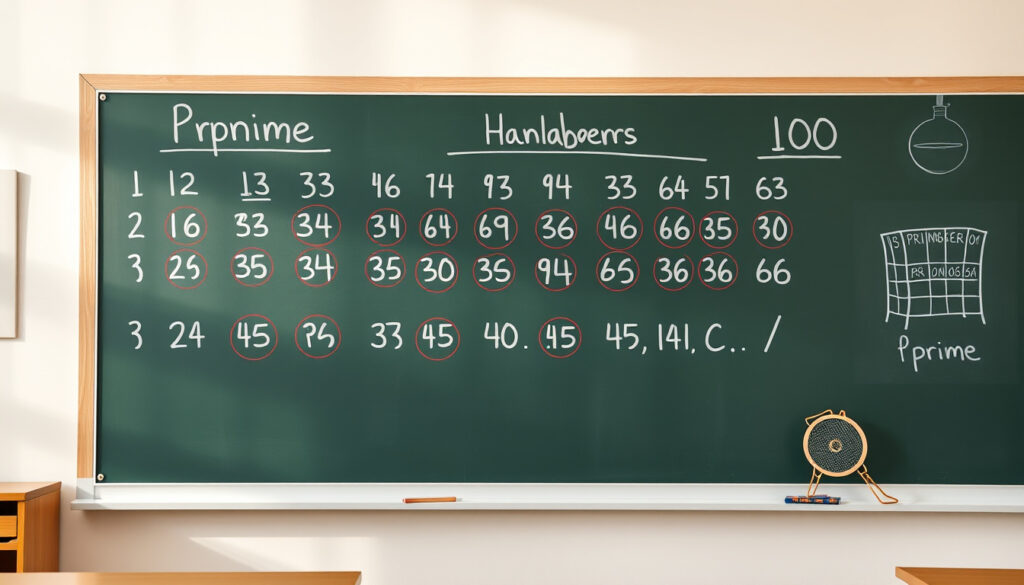
What is a Prime Number? Definition, Examples & List (1-100)
You already know that 2, 3, 5, and 7 are special – they’re called prime numbers. A prime number is any whole number greater than 1 that can only be divided evenly by itself and 1.
Definition: Prime number Natural number >1 with exactly two factors: 1 and itself ·
First few primes 2, 3, 5, 7, 11, 13, 17, 19, 23, 29 ·
Smallest prime 2 (also the only even prime) ·
Number of primes under 100 25 ·
Composite numbers (under 10) 4, 6, 8, 9, 10 ·
1 is neither prime nor composite True
Quick snapshot
- Prime has exactly two factors: 1 and itself (BYJU’S (educational platform))
- 2 is prime; 1 is not prime (BYJU’S (educational platform))
- Euclid proved infinitude of primes circa 300 BCE (Wikipedia (online encyclopedia))
- Distribution of primes: Prime Number Theorem shows density, but exact placement of next prime is unpredictable
- Twin prime conjecture (infinitely many pairs like 11 and 13) remains unproven
- Goldbach’s strong conjecture (every even number >2 is sum of two primes) remains unproven
- c. 300 BCE: Euclid proves infinity of primes (Wikipedia (online encyclopedia))
- c. 200 BCE: Sieve of Eratosthenes developed (Math is Fun (math reference site))
- 1798: Gauss proposes Prime Number Theorem (Wikipedia (online encyclopedia))
- 1896: PNT proved by Hadamard and de la Vallée-Poussin (Wikipedia (online encyclopedia))
- Learning to test any number for primality using simple divisibility checks
- Memorizing the 25 primes under 100 with memory tricks
- Understanding why 1 is excluded from the prime club
Five key facts, one takeaway: prime numbers are the building blocks of all other integers.
| Fact | Value |
|---|---|
| Definition | A natural number greater than 1 that can be divided only by 1 and itself. |
| Smallest prime | 2 (also the only even prime) |
| Primes under 100 | 25 primes |
| Largest known prime | 282589933 – 1 (over 24 million digits, discovered 2018) |
| Fundamental theorem | Every integer >1 is either prime or a unique product of primes (up to order). |
| 1 is neither | 1 has only one factor (itself), so it fails the two-factor rule. |
What this means: once you grasp the two-factor rule, you unlock the entire structure of numbers.
What is a prime number in maths?
Definition of a prime number
- A prime number is a natural number greater than 1 with exactly two distinct positive divisors: 1 and itself (BYJU’S (educational platform)).
- No other number divides it evenly. For example, 7 can be divided only by 1 and 7, so it’s prime. 6 can be divided by 1, 2, 3, 6 – that’s composite.
Examples of prime numbers
- The first ten primes: 2, 3, 5, 7, 11, 13, 17, 19, 23, 29 (BYJU’S (educational platform)).
- Twin prime pairs include (3,5), (5,7), (11,13), (17,19) (BYJU’S (educational platform)).
Prime numbers vs composite numbers
- Composite numbers have more than two factors. For instance, 4 has factors 1, 2, 4 (Math is Fun (math reference site)).
- 1 is not prime because it has only one factor (itself) (BYJU’S (educational platform)).
- 2 is the only even prime; all other even numbers are divisible by 2 (FirstCry (parenting resource)).
The implication: the two-factor rule is all you need to decide if any number is prime – once you test its divisibility.
Any whole number above 1 that cannot be made by multiplying two smaller whole numbers is prime. This simple test works for every number you’ll ever encounter.
The implication: the two-factor rule is the key to identifying primes.
How to explain prime numbers to a child?
Simple analogy: building blocks of numbers
Think of prime numbers as the LEGO bricks of the number world. Just as you can build anything with individual bricks, every number is built from primes. For example, 12 = 2 × 2 × 3 – all primes. This analogy works because children already understand that some pieces cannot be broken down further (Math is Fun (math reference site)).
Visual method using circles or tiles
Give a child 7 tiles and ask if they can arrange them into a perfect rectangle (other than a line). They’ll find only 1 row of 7 or 7 rows of 1 – so 7 is prime. For 8 tiles, they can make a 2×4 rectangle, so 8 is composite.
Interactive activity with the Sieve of Eratosthenes
Write numbers 2 to 100. Circle 2, then cross out every 2nd number. Circle the next uncrossed number (3), cross out every 3rd. Continue. The circled numbers are prime (YouTube – PRIME AND COMPOSITE NUMBERS for Kids). This ancient method, developed by Eratosthenes around 200 BCE, is still the most intuitive way to find primes.
The catch: children grasp the “sieve” faster than any formal definition because they see the pattern emerge visually.
When kids learn primes through tiles or sieves, they build number sense that lasts. The tactile experience turns an abstract concept into a concrete game.
The catch: kids learn best through hands-on methods like the sieve.
How do you easily tell if a number is prime?
Step-by-step divisibility test
- If the number is less than 2, it’s not prime.
- If it’s 2, it’s prime (the only even prime).
- Check if the number ends in 0, 2, 4, 6, 8 (and is >2) – if yes, it’s composite (FirstCry (parenting resource)).
- Check if the number ends in 5 and is >5 – composite.
- Test divisibility by primes up to the square root of the number. For instance, to test 37, check 2,3,5,7 (since √37 ≈ 6). None divides it, so 37 is prime.
Quick tricks using square roots
You only need to divide by primes up to the square root. If none of those primes divides evenly, the number is prime. This dramatically reduces work for large numbers (Math is Fun (math reference site)).
Common mistakes (odd numbers are not always prime)
Many odd numbers are composite: 9 (3×3), 15 (3×5), 21 (3×7), 27 (3×9), 33 (3×11), 39 (3×13), 45 (3×15), 49 (7×7), 51 (3×17), and so on. Don’t assume “odd = prime”.
The trade-off: the divisibility test is reliable but requires practice. The Sieve of Eratosthenes remains the fastest method for lists up to 100.
Six numbers, one pattern: primes have exactly two factors; composites have three or more.
| Number | Prime? | Composite? | Factors |
|---|---|---|---|
| 2 | Yes | No | 1, 2 |
| 3 | Yes | No | 1, 3 |
| 4 | No | Yes | 1, 2, 4 |
| 5 | Yes | No | 1, 5 |
| 6 | No | Yes | 1, 2, 3, 6 |
| 7 | Yes | No | 1, 7 |
| 8 | No | Yes | 1, 2, 4, 8 |
| 9 | No | Yes | 1, 3, 9 |
| 10 | No | Yes | 1, 2, 5, 10 |
What this means: the table shows that every number >1 falls into exactly one of two buckets. Once you learn the pattern for 2–10, you can predict any number’s behavior.
Why are 27 and 51 not prime numbers?
27: factors are 1, 3, 9, 27 (composite)
27 = 3 × 9, so it has four factors. A prime can only have two. Many students mistakenly think 27 is prime because it ends in 7, but the test for 3 (sum of digits = 9, divisible by 3) gives it away immediately.
51: factors are 1, 3, 17, 51 (composite)
51 = 3 × 17. Again, sum of digits (5+1=6) reveals divisibility by 3. A common myth is that numbers ending in 1, 3, 7, or 9 are always prime – but 21, 27, 33, 39, 51, 57, 63, 69, 81, 87, 91, 93, 99 are all composite (BYJU’S (educational platform)).
The pattern: the digit-sum trick for 3 catches many of these impostors. It’s a quick mental filter.
What makes 37 a special prime number?
Prime known for patterns in multiplication
37 is prime (factors: 1 and 37). It belongs to several prime families: sexy primes (linked to 31 and 43) and lucky primes from the Sieve of Josephus (Wikipedia (online encyclopedia)). Also, 37 × 3 = 111, which makes it appear in interesting multiplication patterns.
Appearance in popular culture
37 has become a meme – the “prime temperature” and the go-to number in the “Why is 37 always the answer?” internet joke. But mathematically, 37 is no more prime than 2 or 5; it just has a pleasing ring to human ears.
The catch: 37’s fame is cultural, not mathematical. Every prime is equally “prime” by definition.
What are prime numbers from 1 to 100? (List and trick to remember)
Complete list of primes 1-100
The 25 primes under 100 are:
2, 3, 5, 7, 11, 13, 17, 19, 23, 29, 31, 37, 41, 43, 47, 53, 59, 61, 67, 71, 73, 79, 83, 89, 97 (Math is Fun (math reference site)).
Memory trick: skip multiples of 2, 3, 5, 7
After 2, 3, 5, 7, the rest are numbers that are not multiples of 2, 3, 5, or 7 (and are not 1). This eliminates almost all composites in the range. For example, 11, 13, 17, 19 pass the test.
Sieve of Eratosthenes step-by-step
- Write numbers 2 to 100 in a grid.
- Circle 2, cross out every 2nd number (4, 6, 8, …).
- Circle 3, cross out every 3rd number not already crossed.
- Skip 4 (already crossed). Circle 5, cross out every 5th.
- Continue. The circled numbers are all primes under 100 (YouTube – PRIME AND COMPOSITE NUMBERS for Kids).
The trade-off: memorizing all 25 primes is optional – the sieve gives you the answer every time with a little patience.
Why are 1 and 2 not equal? (Is 1 prime? Is 2 prime?)
Why 1 is not a prime number
1 has only one divisor (itself). The definition of a prime requires exactly two distinct positive divisors. If 1 were prime, the fundamental theorem of arithmetic (unique prime factorization) would break, because every number could be written as 1 × itself × … (BYJU’S (educational platform); Wikipedia (online encyclopedia)).
Why 2 is a prime number
2 has exactly two factors: 1 and 2. It meets the two-factor rule perfectly. It is also the only even prime – all other even numbers have at least three factors (FirstCry (parenting resource)).
The implication: 1’s exclusion is not arbitrary – it ensures the entire system of factorization works correctly.
Confirmed facts and open questions
Confirmed facts
- A prime number has exactly two factors: 1 and itself (BYJU’S (educational platform)).
- 2 is prime; 1 is not prime (BYJU’S (educational platform)).
- Euclid proved the infinitude of primes circa 300 BCE (Wikipedia (online encyclopedia)).
- The Sieve of Eratosthenes reliably finds primes up to any limit (Math is Fun (math reference site)).
What’s unclear
- Distribution of primes: the Prime Number Theorem describes density, but exact placement of the next prime is unpredictable.
- Whether infinitely many twin primes exist (twin prime conjecture) remains an unproven open problem.
- The Riemann Hypothesis, which would explain prime distribution, remains unproven.
- Whether there are infinitely many Mersenne primes is unknown.
The pattern: most questions about primes have clear answers; the deep unsolved mysteries only highlight how elegant the known rules are.
What experts say
“A prime number (or a prime) is a natural number greater than 1 that is not a product of two smaller natural numbers.”
– Wikipedia (online encyclopedia)
“A prime number is a whole number greater than 1 with only two factors – itself and 1.”
“A prime number has exactly two factors, itself and 1.”
“A prime number is a whole number above 1 that cannot be made by multiplying other whole numbers.”
– Math is Fun (math reference site)
Once you internalize the two-factor rule – exactly one way to break it down into 1 and itself – prime numbers become a simple gatekeeper between the building blocks and the composites. For the young learner, the implication is clear: once you understand the two-factor rule, prime numbers become a puzzle you can solve every time. Keep practicing with the list from 1 to 100, and soon you’ll spot primes before they even know they’re composite.
For a more thorough breakdown of the concept, you can explore prime numbers explained in detail with additional examples and a full list up to 100.
Frequently Asked Questions
What is a prime number in simple terms?
A prime number is any whole number greater than 1 that can be divided evenly only by 1 and itself. For example, 7 is prime because only 1 and 7 divide it cleanly.
Why is 1 not a prime number?
1 has only one divisor (itself). A prime must have exactly two distinct divisors. Including 1 would break the fundamental theorem of arithmetic – every number would have many factorizations.
What are the prime numbers from 1 to 100?
The 25 primes under 100 are: 2, 3, 5, 7, 11, 13, 17, 19, 23, 29, 31, 37, 41, 43, 47, 53, 59, 61, 67, 71, 73, 79, 83, 89, 97.
How can you tell if a number is prime quickly?
Check if the number is <2 (not prime). If it’s 2, it’s prime. Then test divisibility by primes up to the square root of the number. If none divides it evenly, it’s prime.
Why are 27 and 51 not prime?
27 = 3 × 9 (four factors) and 51 = 3 × 17 (four factors). Both have divisors other than 1 and themselves, making them composite.
Are all odd numbers prime?
No. Many odd numbers are composite, e.g., 9, 15, 21, 27, 33, 39, 45, 49, 51. Always test for divisibility by small primes.
Is 2 the only even prime number?
Yes. All other even numbers are divisible by 2, so they have at least three factors (1, 2, and themselves).
How many prime numbers are there under 100?
There are 25 prime numbers less than 100.
More related posts
 Tuna Pasta Bake Recipe – Easy 45-Min Family Meal
 Free Childcare for 1 Year Old – Eligibility and How to Apply
 Reinaldo Avila da Silva – Brazil Familicide Case Explained
 Hey Dudes: FTC Settlement, Podiatrist Warnings, Foot Health
 Google Translate English to Urdu: How to Use and Accuracy Tips
 Monthly Salary Calculator UK – Find Your Take-Home Pay After Tax
 Paul Mescal: Age, Net Worth, Relationship & Smoking (2025)
 Find an Obituary for a Specific Person UK: Free Search