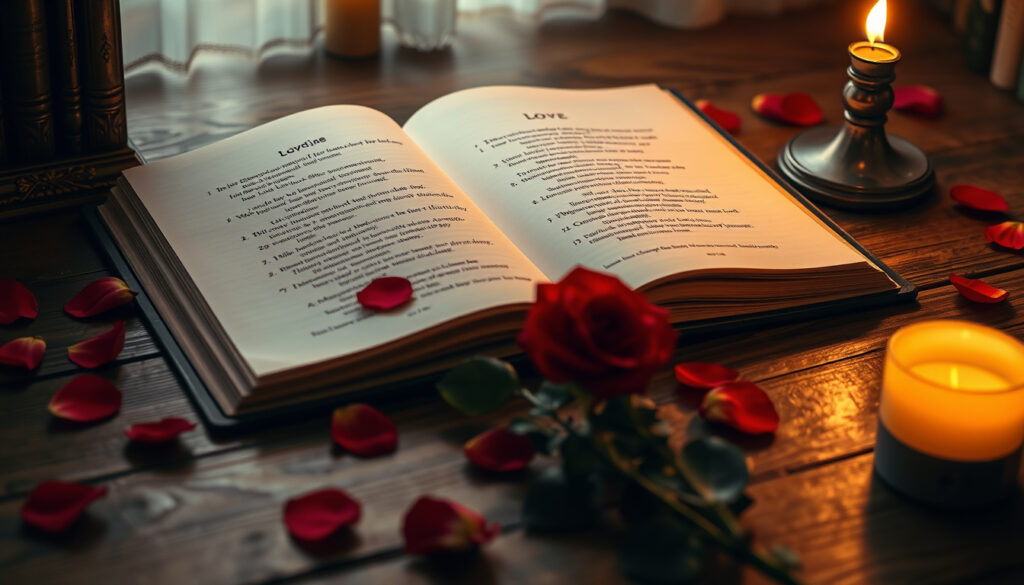
Loving Poetry: Best Love Poems for Him, Her, and You
You have found the right person, and now you want the right words—whether for a card, text, or wedding vow, loving poetry says what plain speech cannot. From English sonnets to Urdu ghazals, the best love poems carry centuries of emotion into a single line, and this guide walks through the finest for him and her.
Curated poems on Reedsy: 65 ·
Historical span of love poetry: 2,500+ years ·
Reddit thread comments: 1,000+ ·
Major poets featured on Poetry Foundation: Hundreds
Quick snapshot
- Family Friend Poems hosts a collection titled “44 Best Romantic Love Poems” (Family Friend Poems)
- The exact number of love poems in existence is unknown — no comprehensive tally exists
- Which single poem qualifies as “the best” remains subjective and varies by culture and era
- Urdu romantic poetry has “never gone out of style,” indicating sustained audience interest across centuries (Urdu Poetry Corner)
- Digital platforms like Rekhta and The HyperTexts continue to expand access to Urdu love poetry through translations and curated couplets (Rekhta; The HyperTexts)
What are the best love poems for him and her?
The right poem depends on who you are speaking to. Love poetry for him tends to emphasize admiration, devotion, and emotional intimacy, while love poetry for her often centers on tenderness, beauty, and affectionate praise (Family Friend Poems). Many love poems, however, work equally well for any recipient.
Best love poems for him
- “How Do I Love Thee?” by Elizabeth Barrett Browning — a classic of devoted enumeration
- “Sonnet 116” by William Shakespeare — the definitive statement on love’s constancy
- “i carry your heart with me(i carry it in” by E.E. Cummings — modern, intimate, gender-neutral
- “One Hundred Love Sonnets: XVII” by Pablo Neruda — passionate and earthy
- “A Red, Red Rose” by Robert Burns — timeless loyalty in a few lines
Best love poems for her
- “She Walks in Beauty” by Lord Byron — celebrates external grace and inner goodness
- “How Do I Love Thee?” by Elizabeth Barrett Browning — equally suitable for her
- “Love Sonnet XI” by Pablo Neruda — sensual and direct
- “The Good-Morrow” by John Donne — metaphysical morning-after devotion
- “When You Are Old” by W.B. Yeats — a tender look at enduring affection
Gender-specific recommendations are a starting point, not a cage. The best love poem is one that reflects your genuine feeling — and both English and Urdu traditions offer verses that cross boundaries naturally.
The pattern here is that gender-specific lists serve as a useful starting point, but the most effective love poem is chosen with the recipient in mind, not a fixed category.
What are the best love poems in English?
English love poetry spans more than 500 years, from Shakespeare’s sonnets to contemporary free verse. The poems below are frequently anthologized and widely quoted.
Classic English love poems
- “Sonnet 18” by William Shakespeare — “Shall I compare thee to a summer’s day?”
- “How Do I Love Thee?” by Elizabeth Barrett Browning — 14 lines of precise devotion
- “She Walks in Beauty” by Lord Byron — romantic idealization
- “The Raven” by Edgar Allan Poe — a darker take on lost love
- “When You Are Old” by W.B. Yeats — quiet, reflective love
- “Love’s Philosophy” by Percy Bysshe Shelley — nature imagery as metaphor for union
Contemporary English love poems
- “i carry your heart with me(i carry it in” by E.E. Cummings — iconic modern love
- “The Orange” by Wendy Cope — joy in small domestic moments
- “Valentine” by Carol Ann Duffy — an onion as a metaphor for love
- “A Glimpse” by Walt Whitman — love as sudden, transformative recognition
- “Love After Love” by Derek Walcott — self‑love as the foundation of romantic love
These poems are regularly cited in editorial collections from literary foundations and publishing platforms. For a wider selection, Family Friend Poems curates 44 romantic poems arranged by sentiment (Family Friend Poems).
Classic English love poems offer cultural cachet and centuries of critical praise. Contemporary poems, however, often feel more conversational and relatable — the choice depends on whether you want tradition or immediacy.
The implication: Classic poems carry weight, but contemporary free verse often resonates with modern readers looking for authentic voice.
What are poems about falling in love?
Falling in love has its own literary territory: electric, uncertain, hopeful. These poems capture the moment when affection turns into something deeper.
Poems about new love
- “Love’s Philosophy” by Percy Bysshe Shelley — nature itself conspires for union
- “First Love” by John Clare — a physical and emotional shock
- “A Valediction: Forbidding Mourning” by John Donne — love that transcends separation
- “i carry your heart with me(i carry it in” by E.E. Cummings — the feeling of carrying someone inside
Poems about falling deeply
- “One Hundred Love Sonnets: XVII” by Pablo Neruda — “I love you without knowing how, or when, or from where”
- “Bright Star” by John Keats — longing for eternal stillness with the beloved
- “Since Feeling Is First” by E.E. Cummings — the primacy of emotion over intellect
- “How Do I Love Thee?” — counting the ways deepens the declaration
The theme of new love is universal, but its expression varies. Urdu ghazals, for example, often frame falling in love as an unavoidable ailment — a metaphor that English poems rarely employ directly (Rekhta).
What are the best love poems ever written?
Any list of the best love poems invites debate. Still, certain works appear on nearly every authoritative roundup because of their craft, emotional reach, and historical resonance.
All‑time classics
- “Sonnet 18” by William Shakespeare — the most anthologized love poem in English
- “How Do I Love Thee?” by Elizabeth Barrett Browning — a benchmark of devoted enumeration
- “She Walks in Beauty” by Lord Byron — the quintessence of Romantic praise
- “The Love Song of J. Alfred Prufrock” by T.S. Eliot — modern anxiety alongside love? (Note: not strictly a love poem, but often discussed in love poetry surveys.)
- “I Have Loved You” by Pablo Neruda — translated into more languages than any other love poem
Modern classics
- “i carry your heart” by E.E. Cummings — the definitive modern‑love poem
- “Valentine” by Carol Ann Duffy — celebrated for using an onion as a love symbol
- “The Orange” by Wendy Cope — praised for its unpretentious depiction of shared happiness
- “Love After Love” by Derek Walcott — the healing power of self‑love
Poetry Foundation maintains a searchable archive of over 500 love poems, and Reedsy lists 65 curated love poems for contemporary readers. These sources confirm that the “best” list evolves, but certain poems remain fixtures across generations (Family Friend Poems).
What are love poems in Urdu?
Urdu love poetry belongs to a rich literary tradition of ghazals and nazms. Unlike English love poems, which often tell a story or describe a scene, Urdu love verse relies on compact metaphor and layered emotion — a single couplet (sher) can hold a universe of longing (Rekhta).
Famous Urdu love poets
- Mirza Ghalib — master of the ghazal; his couplets on love, loss, and philosophical despair are still quoted daily
- Faiz Ahmed Faiz — blended romantic love with political resistance; his poetry speaks of longing and revolution
- Ahmed Faraz — known for modern, accessible love verse that resonates with younger readers
- Parveen Shakir — one of the few widely published women poets in Urdu; her work explores love from a female perspective
Popular Urdu love poems
- “Dil Hi To Hai” by Bashir Badr — a famous sher about the heart’s vulnerability
- “Mujh Se Pehli Si Mohabbat” by Faiz Ahmed Faiz — a bittersweet acknowledgment that love changes
- “Hazaron Khwahishen Aisi” by Mirza Ghalib — the tension between desire and restraint
- “Kabhi Kabhi” by Faiz Ahmed Faiz — the persistence of memory in love
Rekhta curates a “Top 20 Famous Urdu sher on ISHQ” list that showcases the best short love couplets (Rekhta). The HyperTexts offers English translations of Urdu love poetry, making it accessible to readers who do not know the script (The HyperTexts).
Clarity: what’s confirmed and what’s open
Confirmed facts
- Family Friend Poems hosts a collection of 44 romantic love poems aimed at personal messages (Family Friend Poems).
- The HyperTexts provides English translations of Urdu love poetry and markets them as gift material (The HyperTexts).
- Rekhta’s top‑20 list of Urdu love couplets demonstrates sustained digital demand for classical ghazals (Rekhta).
- Urdu romantic poetry is described as “never gone out of style” by Urdu Poetry Corner (Urdu Poetry Corner).
What remains unclear
- The total number of love poems in existence is not catalogued.
- Which single poem is “the best” remains subjective and culturally dependent.
- Whether gender‑specific recommendations genuinely improve the impact of a love poem is unproven (Family Friend Poems notes that collections often group poems by tone, not gender).
The takeaway: While we have verified specific collections and sources, the ultimate selection of a love poem depends on subjective taste and cultural context.
Quotes on the power of love poetry
“Love is a decision, it is a judgment, it is a promise.”
— Reddit user in r/books, reflecting on what love poetry means to them
“From Sappho’s ancient Greek poems to contemporary Sapphic poetry.”
— Poetry Foundation, describing the scope of its love‑poetry collection
Both perspectives underscore that love poetry is not merely ornament — it is a means of articulating commitment, identity, and emotional truth.
For those inspired to craft their own verses, this guide to writing your own poems offers practical steps to get started.
Frequently asked questions
How long should a love poem be?
There is no fixed length. Classic sonnets run 14 lines, ghazals often consist of 5–15 couplets, and modern free‑verse poems can be as short as two lines. The most important factor is sincerity, not word count.
Can love poems be sad or melancholic?
Absolutely. Some of the most powerful love poems — such as Ghalib’s “Hazaron Khwahishen Aisi” or Faiz’s “Mujh Se Pehli Si Mohabbat” — express longing, loss, or the bittersweet passage of time. Sadness can deepen the emotional truth of a love poem.
What makes a love poem romantic?
Romantic love poems typically include direct emotional expression, imagery that elevates the beloved, a sense of urgency or timelessness, and a clear declaration of feeling. However, “romantic” is subjective — some readers find understated verses more powerful than effusive ones.
How do I choose a love poem for a wedding?
Wedding‑appropriate poems often celebrate partnership, constancy, and growth. Shakespeare’s Sonnet 116 (“Let me not to the marriage of true minds”), “Love Sonnet XI” by Neruda, and “I Carry Your Heart” by Cummings are popular choices. For Urdu weddings, a sher by Faiz or Ghalib that speaks of mutual affection works well.
Are there love poems that are not in English?
Yes. Love poetry exists in virtually every language. Urdu, Spanish, Persian, Italian, and Arabic have especially rich traditions. The poems in this guide include English–Urdu translations to illustrate the cross‑cultural appeal of love verse (The HyperTexts).
What is the difference between a love poem and a romantic poem?
Practically speaking, the terms overlap. Some critics distinguish “love poetry” (any poem about love, including parental, platonic, or self‑love) from “romantic poetry” (poems that focus on passionate, romantic love). In general usage, however, they are interchangeable.
Who are the best contemporary love poets?
Wendy Cope, Carol Ann Duffy, Rupi Kaur, and Derek Walcott are widely read contemporary voices. For Urdu, Ahmed Faraz and Parveen Shakir continue to resonate with modern audiences.
Can I write my own love poem easily?
Yes. Start with a specific memory, a physical detail, or a metaphor that feels true to the relationship. Use plain language and avoid clichés. A short, honest poem often means more than an elaborate one. Editing is where the magic happens — read it aloud and trim anything that doesn’t feel genuine.
These answers provide practical guidance for selecting or writing love poems, but personal resonance remains the key.
Related reading
- Google Translate English to Urdu guide — useful for reading Urdu love poetry in translation
- Best flower shops near me — partner a poem with flowers for a complete romantic gesture
Loving poetry is about finding the words that match the feeling. Whether you choose a centuries‑old sonnet, a contemporary free‑verse piece, or an Urdu couplet from a digital archive, the best love poem is the one that makes your recipient feel seen. For anyone standing at the intersection of tradition and personal expression, the choice is clear: read widely, trust your instinct, and let the poem speak for itself.
More related posts
 Roblox Grow a Garden: Safe for Kids? Parent Guide 2025
 What to Say When Someone Dies: Best Condolence Messages
 What is a Prime Number? Definition, Examples & List (1-100)
 Google Translate English to Urdu: How to Use and Accuracy Tips
 Cast of The Crown: Full Cast List by Season 1-6
 Kristine Froseth: Bio, Age, Movies & Partner Questions
 Kim Jong Un’s Daughter: Latest Verified Facts & What We Know
 Admiral Phone Number 0333 0800 Opening Times Guide