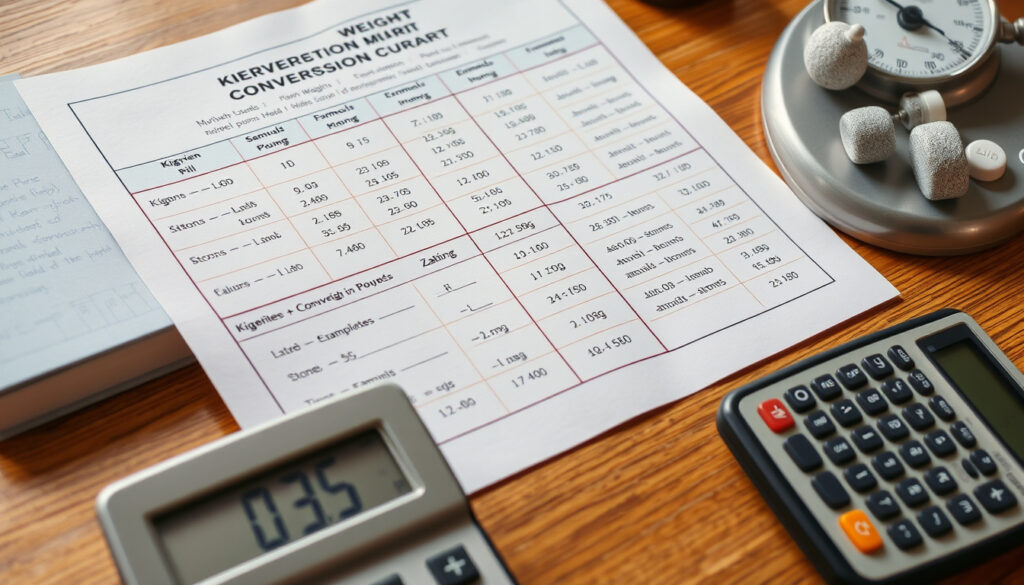
Kgs to Stones and Pounds: Formulas, Charts & Examples
If you’ve ever stepped on a UK bathroom scale and found yourself doing mental gymnastics, you’re not alone. Converting between kilograms and stones—still the standard in British health contexts—requires knowing that one stone equals exactly 6.35029318 kilograms. Below is a complete guide with formulas, worked examples, and NHS-style reference charts to make that conversion second nature.
1 stone equals 6.35029318 kg · 1 stone equals 14 pounds · 60 kg equals 9 stone 6 pounds · 1 kg equals 0.157473 stones · 11 stone equals 69.85 kg
Quick snapshot
- 1 stone = 6.35029318 kg (The Calculator Site)
- 1 stone = 14 pounds avoirdupois (The Calculator Site)
- Rounding practices vary across NHS trusts
- Some charts use 6.35 vs. 6.35029318
- NHS charts updated 2017–2023
- Most NHS trusts standardized on clinical conversion tables
- Step-by-step method for manual conversion
- Common weight examples: 60 kg, 75 kg, 80 kg
The conversion table below summarizes key values for quick reference during everyday weight tracking.
| Conversion | Value |
|---|---|
| 1 stone in kg | 6.35029318 |
| 1 stone in pounds | 14 |
| 1 kg in stones | 0.157473 |
| 60 kg conversion | 9 stone 6 pounds |
| Formula (stones) | kg ÷ 6.35029318 |
| 1 lb in kg | 0.45359237 |
| 70 kg conversion | 11 stone 0.3 lb |
| 75 kg conversion | 11 stone 11 lb |
| 80 kg conversion | 12 stone 8 lb |
| 98 kg conversion | 15 stone 6 lb |
What is kg to stones and pounds?
Kilograms and stones both measure body weight, but they belong to different measurement systems. Kilograms are the standard metric unit used worldwide, while stones remain the conventional unit for expressing human body weight in the UK and Ireland. Converting between them matters because UK NHS services, GP consultations, and bathroom scales typically display weight in stones and pounds rather than kilograms.
Conversion formula
To convert kilograms to stones, divide the kilogram value by 6.35029318. For example, 70 kg ÷ 6.35029318 = 11.03 stones. The whole number (11) represents full stones, and the decimal portion multiplied by 14 gives the remaining pounds.
Basic equivalents
One kilogram equals approximately 0.157473 stones. This means if you’re starting from kilograms and want a direct stones figure, multiplying kg by 0.157473 gives you the total in stones. The Calculator Site conversion reference provides detailed conversion tables verified against multiple NHS and academic sources.
Clinical NHS charts sometimes round 6.35029318 kg to 6.35 kg for simplicity, introducing a tiny error (0.00029318 kg per stone). For everyday bathroom use, 6.35 kg is fine. For medical contexts, the extra decimal places improve accuracy.
What is a stone of weight in kg?
A stone is a unit of weight equal to 14 pounds avoirdupois, used primarily in the UK and Ireland for measuring human body weight. The stone has historical roots dating back centuries, though its exact modern definition was standardized as part of the imperial system. UHSussex NHS Trust official conversion chart publishes official conversion charts beginning at 1 stone (6.35 kg).
Exact definition
One stone equals exactly 6.35029318 kilograms. This precise figure comes from international agreement on the avoirdupois pound (exactly 0.45359237 kg) multiplied by 14. The Calculator Site calculator reference calculates conversions using this exact constant for calculator accuracy.
Pounds relation
The relationship is straightforward: 1 stone = 14 pounds. Since 1 pound equals 0.45359237 kg, multiplying 14 × 0.45359237 confirms the stone-to-kilogram constant. University of Manchester academic resource academic references use the rounded 6.35 kg approximation for general purposes.
How to calculate kg to stone and pounds?
Converting kilograms to stones and pounds involves two steps, and once you know the formula, mental math becomes manageable. York St John University nursing factsheet publishes nursing-specific factsheets with step-by-step methods for clinical accuracy.
Step-by-step method
- Divide your kg value by 6.35029318 to get total stones
- Record the whole number before the decimal — this is your stone count
- Multiply the decimal remainder by 14 to find remaining pounds
- Round pounds to the nearest whole number for practical use
Example: 75 kg ÷ 6.35029318 = 11.81 stones. The 11 is your stones, and 0.81 × 14 = 11.34, so approximately 11 stone 11 pounds. Community Pharmacy Scotland NHS chart provides printable charts that cross-check manual calculations.
Quick mental math
For approximate conversions without a calculator, use 6.35 kg per stone. Divide your kg by 6.35, then multiply the decimal by 14. For 80 kg: 80 ÷ 6.35 = 12.6 stones → 0.6 × 14 = 8.4, so about 12 stone 8 lb. This method works within acceptable everyday tolerance for most non-clinical purposes.
Remember: 10 stone = 63.5 kg exactly (when using 6.35 kg/stone). This benchmark helps you estimate any nearby weight without reaching for a calculator every time.
Is 11 stone 70 kg?
This is a common question because 70 kg frequently appears in health discussions, and 11 stone feels like a “round” figure that should match. The answer requires checking against precise conversion constants.
Verification
Using the exact conversion factor: 11 stone × 6.35029318 kg = 69.853 kg. The Calculator Site verification data confirms 70 kg equals 11 stone 0.3 lb. So 11 stone is approximately 69.85 kg — close to 70 kg, but not exact. The difference is about 150 grams, which matters in clinical settings but not for general weight monitoring.
Common examples
Healthy Weight Grampian NHS Scotland chart provides charts starting at 44.5 kg with 0.5 kg increments, useful for finding exact equivalents. Their Scottish NHS chart confirms conversions through systematic incremental tables.
What weight should a 5ft 3 woman be in stones and pounds?
Healthy weight depends on multiple factors including age, bone density, and muscle mass, but Body Mass Index (BMI) provides a starting reference point. Barnsley CCG NHS BMI integration chart publishes BMI charts that integrate stones alongside kilograms for British clinical use.
BMI context
For an adult woman at 5ft 3in (160 cm), a healthy BMI range of 18.5–24.9 translates roughly to 8–10 stone 7 pounds. Using the formula in reverse: 8 stone (50.8 kg) at 160 cm gives BMI 19.8, while 10 stone 7 pounds (66.2 kg) gives BMI 25.9 — at the upper boundary. Leicester Hospitals NHS malnutrition tool offers online malnutrition screening tools that use kg-to-stone conversions for BMI calculation.
Healthy range
Converting to stones specifically: the NHS healthy weight range for 5ft 3in typically falls between 8 stone 0 lb and 10 stone 7 lb. Using the conversion constant (1 stone = 6.35029318 kg), this translates to approximately 50.8–66.7 kg. These are general guidelines — individual factors vary significantly.
“One stone is equal to 6.35029318 kg.”
“1 stone = 14 pounds = 6.35 kg.”
Related reading: feet to cm conversion · monthly salary calculator UK
This guide aligns with resources like the kg to stones and pounds chart that provide accurate formulas and NHS-style charts for quick reference in daily weight tracking.
Frequently asked questions
How much should I weigh for my height and age?
Healthy weight ranges vary by height, age, and sex. For a 5ft 3in woman, the NHS healthy range is roughly 8–10 stone 7 pounds (50.8–66.7 kg). BMI calculators account for height but age-specific adjustments are individual. Consult a GP for personalized guidance.
What is my ideal weight for my height and age?
Ideal weight uses BMI as a starting reference: healthy BMI is 18.5–24.9. For example, a 5ft 8in (173 cm) adult might aim for 9–12 stone depending on frame size and activity level. The Barnsley CCG NHS BMI chart shows these ranges in stones alongside kg values.
What weight looks best on a 5’3″ female?
Visual perception of weight varies by body composition, clothing, and individual features rather than a single “ideal.” Health-focused targets for this height typically range 8–10 stone 7 pounds, but muscle mass and distribution change the visual appearance at any given weight.
What is the easy trick to convert kg to lbs?
To convert kg to pounds without going through stones first, multiply kg by 2.20462 (the kg-to-pound constant). Alternatively, use the two-step method: kg ÷ 0.45359237 = total pounds, then divide by 14 for stones. York St John University factsheet demonstrates this two-route approach.
What is 60 kg in stone and pounds?
60 kg ÷ 6.35029318 = 9.45 stones. The whole number 9 is stones, and 0.45 × 14 = 6.3 pounds. Rounded practically: 9 stone 6 pounds. This is a commonly-requested conversion appearing on The Calculator Site’s standard reference tables.
What is 75 kg in stone and pounds?
75 kg ÷ 6.35029318 = 11.81 stones. Full stones: 11. Decimal 0.81 × 14 = 11.34 pounds, rounded to 11 stone 11 pounds. UHSussex NHS conversion chart confirms this figure across multiple trust resources.
How many pounds in a stone?
One stone equals exactly 14 pounds avoirdupois. This is an internationally standardized definition: 1 lb = 0.45359237 kg exactly, so 14 × 0.45359237 = 6.35029318 kg per stone. University of Manchester reference academic references confirm this constant.
What is 2 stone in kg?
2 stone × 6.35029318 kg = 12.70058636 kg. Rounded for practical use: 12.7 kg. Using the simpler NHS approximation of 6.35 kg/stone gives 12.7 kg exactly, so both methods align at two decimal places.
For UK residents tracking weight for health reasons, understanding these conversions helps interpret NHS records accurately. Stones and pounds remain standard in British healthcare, so facility with the 6.35 kg/stone constant serves anyone managing weight in the UK context.
More related posts
 5.11 Feet in CM: Exact Conversion + Height Comparisons
 FBI: Most Wanted Season 5 – Episodes, Cast & Schedule Guide
 Ruben Neves: Transfer News, Current Club, Position & Personal Life
 Hey Dudes: FTC Settlement, Podiatrist Warnings, Foot Health
 How Many Words Is This? Count Words in Any Document
 Paul Mescal: Age, Net Worth, Relationship & Smoking (2025)
 Elena Rybakina Profile: Health, Relationships, Career & Facts
 Easter Opening Times: Tesco & Supermarkets Ireland 2026