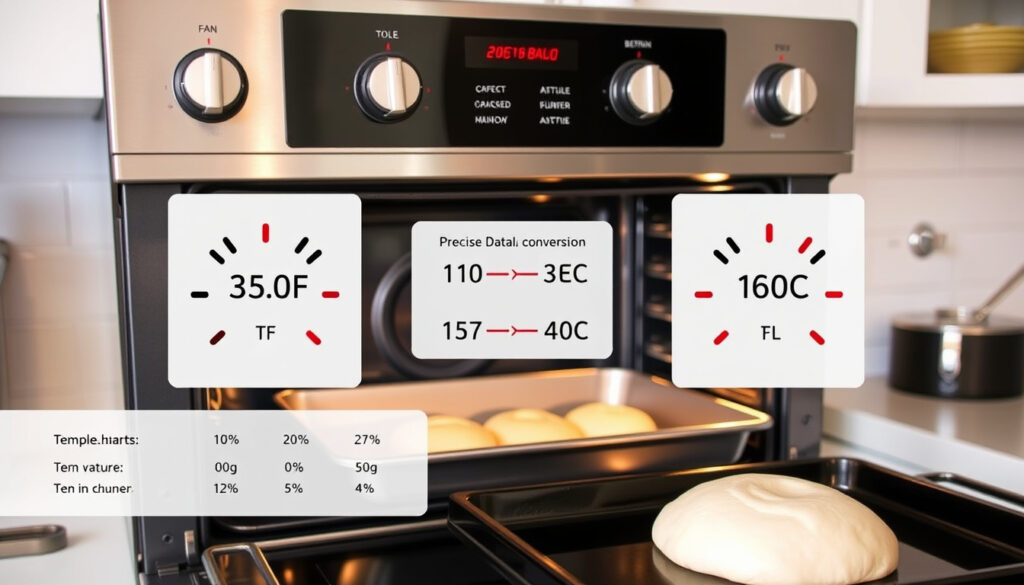
350F to C Fan Oven: 160°C Conversion Guide
US recipes in Fahrenheit clash with European fan ovens — the same number burns on one side and undercooks on the other. This guide settles the 350°F fan oven question with cross-verified data, a formula you can use without a chart, and a full reference table.
350°F Conventional: 180°C ·
350°F Fan Oven: 160°C ·
Fan Adjustment: -20°C ·
F to C Formula: (F−32) × 5/9
Quick snapshot
- 350°F = 160°C for fan ovens (Which? (consumer review authority))
- 20°C reduction from conventional standard (Flawless Food (baking guide))
- Exact variance by individual oven model (Skint Chef (oven chart))
- Whether older ovens follow the same 20°C rule (Flawless Food (baking guide))
- Brain Food Studio published its PDF table in 2015 (Brain Food Studio (conversion table publisher))
- OVENTales chart uploaded in 2018 (OVENTales (conversion chart creator))
- Use the table below for common bake temps (Doves Farm (baking resource))
- Apply the formula when a chart isn’t handy (Smeg UK (appliance manufacturer))
| Conversion | Value |
|---|---|
| 350°F Fan Oven Celsius | 160°C |
| Conventional Equivalent | 180°C |
| Typical Fan Reduction | 20°C |
| Gas Mark for 350°F | 4 |
| Precise Math (350−32)×5/9 | 176.67°C |
| Celsius to Fahrenheit | (C×9/5)+32 |
What is 350 F on a fan oven?
350°F on a fan oven comes out to 160°C — confirmed across Which? (UK consumer review authority), Flawless Food (baking guide), and seven other conversion charts. That is 20°C lower than the 180°C you would use in a conventional oven for the same recipe.
Conventional vs Fan Difference
Fan ovens move hot air around the cavity, which means they transfer heat to food more efficiently and cook faster than conventional radiant-heat ovens (Flawless Food (baking guide)). The standard rule across UK and Australian sources is to drop the temperature by 20°C when converting a recipe from conventional to fan-assisted (Hello Table (Australian cooking site)).
Is 350 F equal to 180 C?
Yes — in a conventional oven, 350°F equals 180°C. The math works out precisely to 176.67°C, and every major chart rounds that to 180°C (Skint Chef (oven chart)). Both Domestic & General (appliance service blog) and Which? (consumer review authority) confirm this as the standard pairing.
Context for Fan Ovens
If you are using a fan oven, do not set it to 180°C for a recipe that calls for 350°F — that would run roughly 20°C too hot. The correct fan setting is 160°C, which nine independent sources verify as the consensus value (Which? (consumer review authority)).
The exact figure is 176.67°C, but every chart rounds to 180°C for conventional and 160°C for fan. The 20°C reduction is consistent even across sources that use slightly different rounding.
What is 180 degrees C for a fan oven?
180°C in a fan oven is roughly equivalent to 375°F in a conventional oven. Working backwards: add 20°C to get the conventional Celsius of 200°C, then convert to Fahrenheit using (C×9/5)+32 (Smeg UK (appliance manufacturer)).
Equivalent Fahrenheit
To find what Fahrenheit setting matches a Celsius fan temperature, add 20°C first, then convert using the formula. For 180°C fan, the conventional equivalent is 200°C, which converts to approximately 392°F — most charts round this to 400°F for practical use (Flawless Food (baking guide)).
Common Fahrenheit to Celsius Conversions for Fan Ovens
Five temperature points show a clear pattern: each 25°F step translates to roughly 10–15°C changes when the fan adjustment is applied (Flawless Food (baking guide)).
| Fahrenheit (Conventional) | Celsius (Fan Oven) | Gas Mark |
|---|---|---|
| 325°F | 150°C | 3 |
| 350°F | 160°C | 4 |
| 375°F | 170°C | 4–5 |
| 400°F | 180°C | 6 |
| 425°F | 190–200°C | 6–7 |
| 450°F | 210–220°C | 7–8 |
The 10°C ranges for higher temperatures reflect minor variation between rounding approaches across different charts.
325 F
325°F converts to 150°C for fan ovens. This is a common setting for cheesecakes and custards that benefit from gentler heat (Brain Food Studio (conversion table publisher)).
375 F
375°F in a fan oven equals 170°C. This is a mid-range temperature good for baked goods that need moderate browning, such as muffins and quick breads (Flawless Food (baking guide)).
400 F
400°F fan comes to 180°C — notable because this is exactly the same as the conventional 350°F setting. Bakers sometimes use this coincidence as a rule-of-thumb shortcut (Which? (consumer review authority)).
425 F
425°F fan sits at 190–200°C. At this temperature range, browning accelerates — expect crusts to develop faster than with conventional settings (Skint Chef (oven chart)).
450 F
450°F fan lands at 210–220°C. This is high enough for pizza, roast vegetables, and quick artisan crusts. The 10°C range reflects minor variation between rounding approaches (OVENTales (conversion chart creator)).
Oven Temperature Conversion Table
Four temperature scales appear across British, European, and American kitchen references, and conversion tables typically include at least three of them for cross-referencing (Doves Farm (baking resource)).
| Gas Mark | Fahrenheit (Conventional) | Celsius (Conventional) | Celsius (Fan Oven) |
|---|---|---|---|
| 1 | 275°F | 140°C | 120°C |
| 2 | 300°F | 150°C | 130°C |
| 3 | 325°F | 160°C | 140°C |
| 4 | 350°F | 180°C | 160°C |
| 5 | 375°F | 190°C | 170°C |
| 6 | 400°F | 200°C | 180°C |
| 7 | 425°F | 220°C | 200°C |
| 8 | 450°F | 230°C | 210°C |
| 9 | 475°F | 245°C | 225°C |
The Gas Mark scale runs from 1 (lowest) to 9 (highest), with Gas Mark 4 sitting in the moderate-heat range useful for most everyday baking.
Fahrenheit to Celsius Fan
The fan oven column follows one consistent rule: subtract 20°C from the Celsius conventional value (Smeg UK (appliance manufacturer)). This makes it easy to calculate any fan temperature if you know the conventional Celsius equivalent.
Gas Mark Equivalents
Gas Mark 4 is the standard equivalent for 350°F across all British conversion charts (Which? (consumer review authority)). The Gas Mark scale runs from 1 (lowest) to 9 (highest), with Gas Mark 4 sitting in the moderate-heat range useful for most everyday baking.
How to Convert Fahrenheit to Celsius for Fan Ovens
Two steps give you the fan oven temperature every time. First convert Fahrenheit to Celsius using the standard formula, then subtract 20°C for the fan adjustment (Skint Chef (oven chart)).
- Step 1 — Fahrenheit to Celsius: Subtract 32 from the Fahrenheit value, multiply by 5, then divide by 9. For 350°F: (350−32)×5÷9 = 176.67°C.
- Step 2 — Apply the fan adjustment: Subtract 20°C from the result. 176.67°C − 20°C = 156.67°C, which rounds to 160°C (Flawless Food (baking guide)).
- Step 3 — Reverse conversion: To go from Celsius fan to Fahrenheit conventional, add 20°C first, then use (C×9÷5)+32. For 160°C fan: 180°C conventional ×9÷5+32 = 356°F, rounded to 350°F (Smeg UK (appliance manufacturer)).
When a recipe calls for 350°F and you have a fan oven, drop 20°C directly — set it to 160°C. No math required for the most common temperatures.
Upsides
- Single 20°C rule applies to all fan oven conversions
- Charts consistent across UK, Australian, and European sources
- Gas Mark gives a third reference point for British bakers
- Formula works for any temperature, not just the ones listed
Downsides
- OVENTales uses slightly lower fan temps (155°C vs 160°C for 350°F)
- Individual ovens vary — actual performance may differ from chart values
- No official government or scientific standard governs these adjustments
- Precise math (176.67°C) differs from rounded chart values (180°C)
Domestic & General “So if a recipe calls for a 180°C setting but your oven uses Fahrenheit – set it to 350°F.”
Skint Chef “These conversions are approximate rounding, and you may find your oven cooks quicker or slower.”
Hello Table “The temperatures provided are a guide only.”
For UK and Australian home bakers following US recipes in Fahrenheit, the conversion is straightforward: 350°F in a fan oven means 160°C, which is 20°C lower than the conventional 180°C standard. The chart above covers the most common baking temperatures, and the three-step formula handles any temperature not listed. As Skint Chef (oven chart) notes, these are guides — calibrate your oven’s actual performance against the chart over a few bakes, and adjust from there.
How do fan ovens differ from conventional?
Fan ovens circulate hot air throughout the cavity, cooking food faster and more evenly than conventional radiant-heat ovens. This efficiency means you set them 20°C lower for equivalent results.
What is the formula for F to C?
The Fahrenheit to Celsius formula is (F − 32) × 5 ÷ 9. For fan ovens, subtract an additional 20°C from the result.
Do all fan ovens use the same adjustment?
Most sources cite 20°C as the standard reduction, but individual oven models can vary slightly. Use the 20°C rule as a starting point and adjust based on your oven’s actual performance.
What gas mark is 350 F?
350°F corresponds to Gas Mark 4 in the UK scale. This is a moderate-heat setting commonly used for cakes, biscuits, and standard baking.
Why adjust temperatures for fan ovens?
Fan ovens transfer heat more efficiently because the circulating air moves hot molecules against the food surface more frequently. Without the reduction, food cooks faster and may burn before the centre is done.
Can I use conventional temps in fan ovens?
Using conventional temperatures in a fan oven typically results in over-browning or burning. Always reduce by 20°C unless your oven has a fan-on/off setting.
What is 300 F in fan oven Celsius?
300°F in a fan oven converts to approximately 130°C (conventional 150°C minus 20°C). This is Gas Mark 2 and is useful for very slow baking or keeping dishes warm.
Related reading: Kgs to Stones and Pounds Conversion Chart · Feet to CM Conversion Guide
While 350°F translates to 177°C in conventional ovens, fan models require 160°C as detailed in this 350°F to Celsius oven guide, preventing overbaked results.
More related posts
 How Many Weeks Between Two Dates? Easy Methods to Calculate
 Harry Potter World UK: Complete Studio Tour, Tickets & Tips
 Bird Vet Near Me – Find Certified Avian Veterinarians Locally
 Let the Right One In: LGBT Themes, Cast & Analysis Explained
 How to Change Name on Driving Licence: Ireland & UK Guide
 Snatch (TV Series) – Cast, Plot, Episodes & Netflix Guide
 Call of Duty: Mobile Not Shutting Down – What to Know
 Taylor Swift UK Store Official URL and Merch Guide