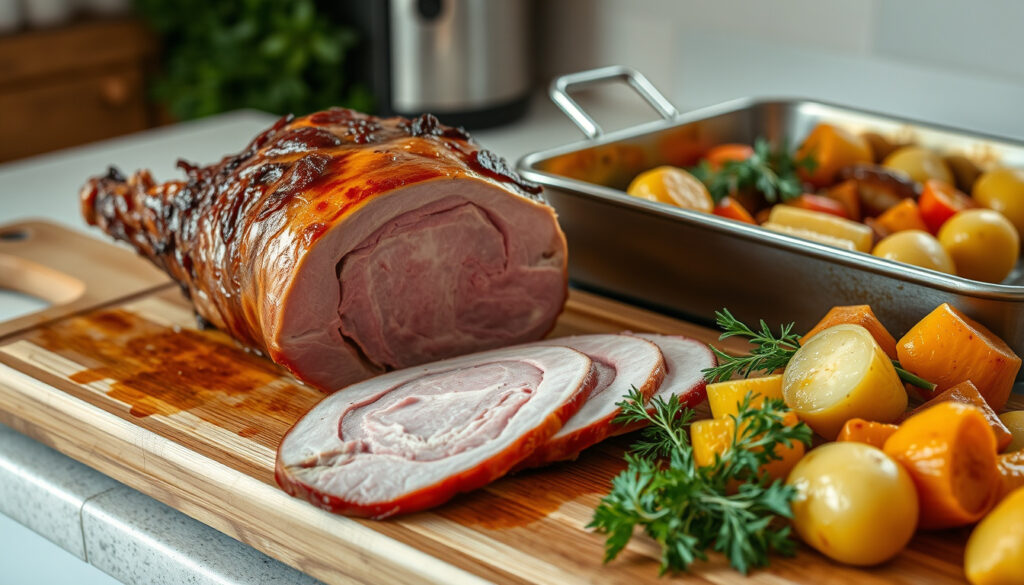
How to Cook Gammon Joint: Boil vs Roast & Best Methods
Few kitchen debates divide opinion quite like whether to boil a gammon joint before roasting. The choice affects texture, saltiness, and cooking time in ways that aren’t always obvious. This guide compares the main methods with exact timings, temperatures, and glaze tips, so you know exactly what to do for a moist, flavourful joint every time.
Typical joint weight: 1–2 kg ·
Boiling time per 500g: 20 minutes ·
Roasting temperature: 200°C (400°F) ·
Roasting time after boiling: 20–30 minutes ·
Safe internal temperature for ham: 71°C (160°F) ·
Common glaze base: honey and mustard
Quick snapshot
- Boil 20 minutes per 500g before roasting (True Bites butcher’s guide)
- Internal temperature must reach 71°C (160°F) for safety (USDA FSIS)
- Resting 15–20 minutes before carving retains juices (True Bites butcher’s guide)
- Whether pre-boiling is strictly necessary for modern gammon joints (True Bites butcher’s guide)
- Optimal foil usage – some wrap, some don’t – and how it affects moisture (DukesHill ham guide)
- Whether 20–30 minutes at 200°C after boiling is universally sufficient for all joint sizes (Mayfair Foodie blog)
- Typical sequence: boil → glaze → roast → rest. Total time for a 1.5kg joint: ~1 hour 10 minutes (BBC Good Food recipe site)
- Rest the joint 15–20 minutes before carving (True Bites butcher’s guide)
- Slice against the grain for maximum tenderness (BBC Food recipe authority)
| Label | Value |
|---|---|
| Weight range | 1–2 kg (typical) |
| Boiling time (per 500g) | 20 minutes |
| Roasting time (after boiling) | 20–30 minutes at 200°C |
| Internal safe temperature | 71°C (160°F) |
| Common glaze ingredients | honey, mustard, brown sugar, cloves |
What’s the best way to cook gammon joints?
The answer depends on what you value: tenderness, a salty-sweet balance, crisp fat, or convenience. Four main methods exist, each with distinct trade-offs.
What are the main cooking methods?
- Boil then roast – The classic British approach. Simmering first removes excess salt and pre-cooks the meat, then a hot oven creates a glazed crust.
- Roast only (no boil) – Skip the pot for a firmer texture and more concentrated pork flavour. Requires basting or foil to prevent drying.
- Slow cooker – Set-and-forget method that produces very tender meat with no pre-boiling.
- Air fryer – Quick cooking that yields a crisp exterior, suitable for smaller joints.
Which method is most popular?
According to search data and recipe sites, the boil-then-roast method dominates UK kitchens. BBC Good Food’s honey-glazed gammon and BBC Food’s roast gammon both use this two-stage process, drawing millions of views annually.
Do I need to boil a gammon joint before roasting?
This is the question that sparks kitchen arguments. The short answer: it’s optional, but the reasons for boiling are rooted in old curing methods.
Why do people boil gammon before roasting?
Traditional curing used heavy salt to preserve the meat. Boiling draws out that excess salt, as True Bites butcher’s guide explains. It also pre-cooks the joint, cutting total oven time by roughly half. Mayfair Foodie blog adds a blanching step – covering the gammon with cold water, bringing it to a boil, then draining – to remove scum and further reduce salt.
How long should you boil a gammon joint?
The standard is 20 minutes per 500g, plus an extra 20 minutes at the end. Both True Bites butcher’s guide and BBC Food recipe authority agree on this timing. For a 1.5kg joint, that’s 1 hour 20 minutes of simmering. After boiling, drain the water (or reserve for stock), then glaze and roast.
Modern curing techniques have reduced salt levels significantly, as True Bites butcher’s guide notes. So boiling is becoming less necessary for salt control, but still helps achieve a softer, uniformly cooked texture.
How to cook a gammon in the oven?
Oven roasting is the most common finishing step, whether you’ve boiled first or not. Here’s the precise method.
Do you roast gammon covered or uncovered?
Start covered. Wrap the joint tightly in foil for the first part of roasting – this traps steam and keeps the meat moist. For a joint that has been boiled first, you only need 20–30 minutes in the oven, so you can go uncovered the whole time if you prefer a drier crust. BBC Good Food recipe site recommends uncovering for the final 10–15 minutes to crisp the fat and caramelise the glaze.
What temperature should you use?
Set the oven to 200°C (400°F), or 180°C fan. True Bites butcher’s guide gives a general rule: roast at 190°C / 170°C fan for 30 minutes per 500g plus 30 minutes extra if starting raw. But if you’ve boiled first, the oven time drops to just 20–30 minutes total – enough to set the glaze and warm through.
A home cook who skips boiling must roast longer and risk a drier result. Boiling first turns the oven into a finishing tool rather than the main cooking event, saving energy and guaranteeing moisture.
Do you wrap gammon in foil to cook?
Foil plays different roles at different stages. Getting it right prevents burnt fat and keeps the joint succulent.
Does wrapping affect moisture or browning?
During the boil stage, foil is not needed – the joint is fully submerged in water. During roasting, foil is optional. Covering for the early stage locks in moisture, especially if you haven’t boiled. Uncovering for the final stretch allows the fat to crisp and the glaze to bubble. DukesHill ham guide suggests removing the rind before glazing for a clean finish.
Should foil be used during glazing?
No – the glaze needs direct heat to set. Apply the glaze after boiling (or after the first covered roast period), then place the joint uncovered in the hot oven. Jamie Oliver chef and cookbook author recommends scoring the fat, studding with cloves, brushing on the glaze, and roasting uncovered at 200°C until golden.
Wrapping too early or too tightly can steam the glaze into a soggy layer. Always uncover for at least the last 15 minutes of roasting to develop that sticky, caramelised finish.
Is it better to boil a gammon joint or roast it?
The choice really comes down to texture and salt preference. Neither is universally superior – they suit different occasions and tastes.
Advantages of boiling before roasting
- Guarantees a moist, tender result with even doneness.
- Removes excess salt (useful for traditionally cured gammon).
- Reduces oven time, making it more energy-efficient.
Advantages of roasting only
- Produces a firmer, more porky flavour.
- Creates a crispier fat cap without any sogginess.
- Simplifies the process – one less pot to wash.
Four factors, one pattern: the decision boils (pun intended) down to how much salt is in your joint and how soft you want the meat to be. The comparison table below makes the trade-offs explicit.
| Factor | Boil then Roast | Roast Only |
|---|---|---|
| Texture | Tender, pulls apart easily | Firm, sliceable |
| Salt level | Reduced significantly | As-is from curing |
| Oven time (1.5kg) | 20–30 minutes | About 2 hours (True Bites butcher’s guide) |
| Fat crispiness | Moderate (requires uncovered finish) | Excellent (full oven exposure) |
| Effort | Two stages, two pots | One stage, one pot |
| Best for | Holiday feasts, large gatherings | Weekend roast, firmer preference |
The implication: choosing between methods depends on whether you prioritise tenderness or crust, and how much oven time you want to commit.
Step‑by‑step: how to cook a gammon joint (boil‑then‑roast method)
This classic method delivers the most consistent results. Follow these steps exactly for a moist, glazed joint.
- Weigh the joint – Calculate boiling time: 20 minutes per 500g, plus 20 minutes. Example: 1.5kg = (3 × 20) + 20 = 80 minutes.
- Soak (optional) – If the joint is heavily salted, soak in cold water for 24 hours, changing the water once, per DukesHill ham guide.
- Blanch (optional) – Cover with cold water, bring to a boil, drain, and rinse. Mayfair Foodie blog recommends this to remove scum.
- Simmer – Place gammon in a large pot, cover with fresh water. Add aromatics (bay leaf, peppercorns, onion, carrot) if desired. Bring to a gentle simmer, not a rolling boil. Cook for the calculated time.
- Preheat oven – Heat to 200°C (180°C fan).
- Glaze – Remove gammon from pot. Score the fat in a diamond pattern. Press a clove into each diamond if you like. Brush on glaze (mix honey, mustard, brown sugar).
- Roast – Place on a rack in a roasting tin. Roast uncovered for 20–30 minutes, basting twice with the glaze. Internal temperature must reach 71°C (USDA FSIS).
- Rest – Let the joint rest for 15–20 minutes before carving (True Bites butcher’s guide).
- Carve – Slice against the grain for tender pieces.
What we know and what remains unclear
Confirmed facts
- Boiling 20 minutes per 500g is the standard pre-cooking time, backed by True Bites butcher’s guide and BBC Food recipe authority.
- Resting 15–20 minutes before carving retains juices and improves texture (True Bites butcher’s guide).
- Internal temperature must reach 71°C for food safety (USDA FSIS).
What’s unclear
- Whether pre-boiling is strictly necessary for all modern gammon joints – True Bites butcher’s guide notes that current curing is less aggressive.
- Optimal foil usage: some sources recommend wrapping, others don’t, and the impact on moisture is not systematically measured.
- Whether 20–30 minutes at 200°C after boiling is sufficient for all joint sizes and shapes – Mayfair Foodie blog notes variability.
Expert perspectives on gammon cooking
“Simmer the gammon for 20 minutes per 500g plus an extra 20 minutes. Then glaze and roast at 200°C for 20–25 minutes until golden.”
— BBC Food recipe authority
“For a traditional honey-glazed gammon, roast at 190°C for 20 minutes per 450g plus an extra 20 minutes. The glaze should be applied halfway through.”
— BBC Good Food recipe site
“Add carrots, celery, bay leaves and peppercorns to the boiling liquid – it gives the meat a subtle, aromatic flavour that works beautifully with a honey-mustard glaze.”
Related reading: How to Cook Perfect Gammon at Home · Gammon Recipe: The Definitive Guide to Cooking Perfect Glazed Gammon
For a comprehensive guide, you can learn how to cook gammon joint perfectly with step-by-step instructions and timing.
Frequently asked questions
How to cook a gammon joint in a slow cooker?
Place the joint in the slow cooker, add a cup of water or cider, and cook on low for 6–8 hours. Glaze and finish under the grill for 5 minutes if you want a sticky top. No pre-boiling needed (BBC Good Food recipe site).
How to cook a gammon joint in the oven without boiling?
Roast the raw joint at 190°C (170°C fan) for 30 minutes per 500g plus 30 minutes extra. Wrap in foil for the first two-thirds of cooking to retain moisture, then uncover to glaze and crisp (True Bites butcher’s guide).
How to cook gammon joint in an air fryer?
For a 1kg joint, air fry at 180°C for 30–40 minutes, flipping halfway. No boiling required. Glaze in the last 10 minutes. Ensure internal temperature reaches 71°C.
How to cook a moist gammon joint?
Boil first – this is the single best guarantee of moisture. Then roast only long enough to set the glaze (20–30 minutes). Resting for 15–20 minutes before carving also retains juices (True Bites butcher’s guide).
How to boil a gammon joint?
Place in a large pot, cover with cold water, add aromatics if desired. Bring to a gentle simmer, then cook for 20 minutes per 500g plus 20 minutes. Drain and proceed to glazing and roasting.
Why do people boil gammon?
To remove excess salt from traditional curing and to pre-cook the meat, resulting in a more tender, uniformly cooked joint that requires less oven time (True Bites butcher’s guide).
Can I cook gammon joint from frozen?
Yes, but it’s not recommended. If necessary, increase boiling time by 50% and ensure the internal temperature reaches 71°C before glazing. Thawing overnight in the fridge yields better results.
For the home cook who wants a reliable centrepiece, the boil-then-roast method is still the safest route. But modern curers have made the decision less clear-cut. The trade-off is clear: if you prioritise tender, evenly cooked meat that isn’t overly salty, take the time to boil. If you want a firmer, more rustic roast with intense pork flavour and a crackling-like fat cap, go straight to the oven. For the British weekend roaster, the choice between these two paths determines whether you spend an extra hour at the hob or get the joint in the oven and walk away – both can lead to a spectacular glazed gammon, as long as you check that temperature.
More related posts
 Classic Football Shirts Manchester – Guide to Iconic Retro Kits
 Lynx Africa Deodorant Discontinued? Truth Behind the Stunt
 Randy Rhoads Plane Crash: Death and Last Words
 Sign of Diabete in Women: Early & Female-Specific Symptom
 Michael Jordan Net Worth 2026: $4.3 Billion Nike Empire
 Easter Opening Times: Tesco & Supermarkets Ireland 2026
 Google Translate English to Urdu: How to Use and Accuracy Tips