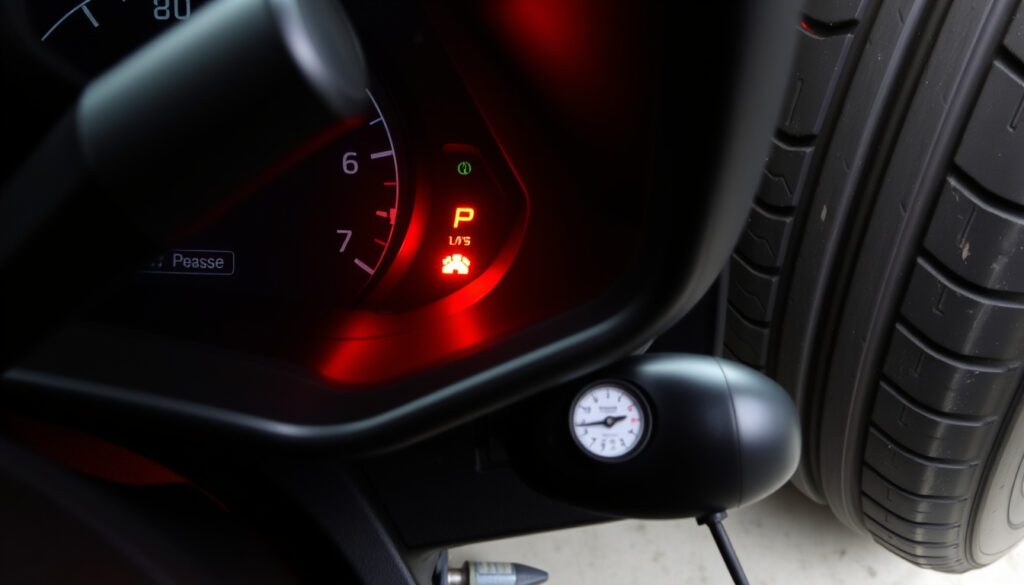
Tyre Pressure Warning Light: Why It’s On & How to Reset
You’re driving along when a little orange symbol shaped like a flat tyre cross-section lights up on your dashboard. That’s the tyre pressure warning light doing its job, and it’s not always as straightforward as a simple flat tyre.
Vehicles with TPMS in US: 100% of 2008+ models · Typical trigger pressure drop: 25% below recommended · Average TPMS sensor replacement cost: $200–$300 per sensor · Most common tyre pressure for cars: 32–34 psi (cold)
Quick snapshot
- Monitors tyre pressure in real time (NHTSA (US safety regulator))
- Warns when pressure drops significantly (Consumer Reports (independent testing org))
- Mandatory on cars sold in US/Europe since 2008/2014 (European Commission (EU regulatory body))
- Temperature changes (Kings Toyota (Toyota dealer advice))
- Sensor battery dying (Consumer Reports (independent testing org))
- Faulty sensor or communication (Les Schwab (national tyre chain))
- Reduced traction and braking (Consumer Reports (independent testing org))
- Increased fuel consumption (Consumer Reports (independent testing org))
- Risk of blowout at high speed (NHTSA (US safety regulator))
- Premature tyre wear (Firestone (tyre service chain))
- Sensor replacement: $200–$300 (TireBuyer (tyre retailer))
- Legal liability if accident occurs (Firestone (tyre service chain))
Four key facts, one pattern: the TPMS light isn’t lying — it’s just not telling you everything. Here’s the data behind the warning.
| Fact | Value |
|---|---|
| TPMS trigger threshold | ~25% below the recommended pressure (Consumer Reports) |
| Average sensor lifespan | 5–10 years (battery life) (Consumer Reports) |
| Common cold tyre pressure | 32–34 psi for most passenger cars (Toyota dealer advice) |
| Ford Kuga 2023 typical pressure | 35–38 psi front, 32–35 psi rear |
Why is my tyre pressure light on when my tyres are fine?
Four common reasons, and none of them means your tyres are necessarily flat. Let’s start with the one most drivers overlook.
Temperature changes and air density
- A drop of 10°F in outside air temperature can lower tyre pressure by 1-2 psi (Kings Toyota (Toyota dealer)).
- The TPMS triggers when pressure drops ~25% below the manufacturer’s recommended cold tyre pressure (Consumer Reports).
- If your baseline is 32 psi, a 25% drop means the light comes on at roughly 24 psi — which can happen on a cold morning without any leak at all.
TPMS sensor battery failure
- Each sensor has an internal battery that typically lasts 5-10 years (Consumer Reports (independent testing org)).
- When the battery is low, the sensor stops communicating reliably — the dashboard light can flicker or stay on even at correct pressure.
- Symptoms: intermittent warning, or the light comes on only in cold weather but disappears after a long drive.
Slow puncture not visible to the eye
- A nail or screw in the tread can cause a leak of just 1-2 psi per day — barely noticeable on a visual check but enough to trigger the TPMS after a few days.
- Hand-checking pressure with a gauge is the only reliable method to confirm. The light may appear after a 50-mile drive because heat builds up and the leak accelerates.
Sensor calibration or communication error
- After a tyre rotation or replacement, the TPMS system may need recalibration to recognise the new sensor positions (Fleetio (fleet management platform)).
- Some vehicles require a dedicated recalibration procedure, not just a simple reset.
A temperature drop of just 10°F can reduce tyre pressure by 1-2 psi — enough to bring a borderline tyre under the TPMS threshold without any actual leak. The light may go off by itself after a 20-minute drive when the air inside warms up. But that doesn’t mean you should ignore it.
Can I drive with a tyre pressure warning light?
Short answer: you can, but you shouldn’t. Here’s the breakdown of risk, legality and distance.
Immediate risks of low tyre pressure
- Under-inflated tyres increase stopping distance significantly and reduce cornering grip (Consumer Reports (independent testing org)).
- At high speeds, low pressure causes excessive sidewall flex, overheating, and a potential blowout — especially in hot weather.
Recommended maximum distance before checking
- Most manufacturers advise driving no more than 50 miles at reduced speed if the TPMS light comes on (Consumer Reports (independent testing org)).
- Aim to reach a safe spot to check pressures within 10-20 miles if you’re on a highway.
- If the light is flashing (not steady), it indicates a system malfunction — stop sooner and get the vehicle inspected.
Effect on fuel economy and tyre wear
- Running tyres at 80% of recommended pressure reduces fuel efficiency by up to 3% (Consumer Reports (independent testing org)).
- Under-inflated tyres wear on the outer edges prematurely, shortening their lifespan by thousands of miles.
Legal status of driving with TPMS warning
- In the US, there is no direct penalty for driving with the TPMS light alone — but driving on under-inflated or damaged tyres is illegal and can lead to fines or liability in an accident.
- In the EU and UK, the same principle applies: the light itself isn’t illegal, but unsafe tyres are. Annual vehicle inspections (MOT in the UK, TÜV in Germany) can fail a car for a faulty TPMS.
A steady TPMS light means low pressure somewhere. A flashing light means the system itself has a fault — and that can’t be fixed by adding air. If yours blinks for 60-90 seconds at startup before staying on, it’s a sensor problem, not a tyre problem.
What is the correct tyre pressure for a Ford Kuga?
Ford Kuga owners ask this more than almost any other model. Here’s what you need to know, straight from the numbers.
Ford Kuga recommended pressures by model year (2023)
- Front tyres (partial load): 35–38 psi depending on engine variant.
- Rear tyres (partial load): 32–35 psi.
- Full load or towing: higher values — check the pressure label inside the driver’s door pillar.
How to find the pressure label in your vehicle
- Look on the driver’s side door pillar (visible when the door is open) or inside the fuel filler flap.
- The label shows the manufacturer’s recommended cold pressure for front and rear axles, for partial and full load.
- If the label is missing, check the owner’s manual or the Ford UK website — tyre pressure figures are also published in the vehicle’s technical data.
Differences between front and rear pressures
- Most front-wheel-drive SUVs like the Kuga require slightly higher front pressure because the engine sits over the front axle.
- Rear pressure is usually 2-4 psi lower for standard driving, but equalising for load distribution is safe within the recommended range.
Adjusting for load and towing
- When carrying heavy loads or towing a trailer, increase rear tyre pressure to the ‘full load’ figure printed on the label — often 38-42 psi.
- Overinflating rear tyres for a single heavy trip is acceptable; just return to standard pressure afterwards.
Why this matters: using the wrong pressure — even 5 psi off — can trigger the TPMS light prematurely or, worse, reduce stability at motorway speeds. The Kuga’s recommended range is specific; don’t assume ’30-35 psi works for everything’.
How do I reset the tyre pressure warning light?
Six methods, depending on your car. Most drivers need only the first one.
Resetting via dashboard menu (common method)
- Navigate to the tyre pressure menu in your infotainment or instrument cluster settings.
- Select ‘Reset’ or ‘Calibrate’ — the system may require you to confirm that current pressures are correct.
- After reset, the system may take 10-20 minutes of driving at speeds above 15 mph to recalibrate.
Using the reset button under the steering wheel or glovebox
- Some vehicles (Toyota, Honda, some Ford models) have a dedicated TPMS reset button — often located under the steering column or inside the glovebox (Toyota dealer procedure).
- Procedure: turn the ignition to ‘ON’ (don’t start the engine), press and hold the reset button until the TPMS light blinks three times, then release. Drive a short distance to confirm.
Automatic reset after driving a few miles
- Indirect TPMS systems (which rely on wheel speed sensors rather than internal pressure sensors) reset automatically after you’ve inflated tyres to the correct pressure and driven at moderate speed for 10-20 minutes (Les Schwab (national tyre chain)).
- No button pressing needed — just drive normally after a pressure check.
When manual reset is necessary
- After tyre rotation or replacement, the TPMS sensors may need recalibration with a scan tool at a dealer — costing $100-250 for a full relearn (Firestone (tyre service chain)).
- Battery disconnection can also clear the system, but it’s a last-resort method: disconnect the positive battery cable, honk the horn for 3 seconds to drain residual power, then reconnect and drive 10-15 miles.
- Do not leave the reset button pressed permanently just to hide the light — ignoring a real pressure problem can cause a blowout.
The ‘overinflate by 3 psi then deflate fully’ method is widely shared online but can damage the valve core or sensor. Stick to the manufacturer’s reset procedure in the owner’s manual. If the light stays on after a proper reset, the sensor battery is likely dead or the sensor itself is faulty.
How much does it cost to fix a tyre pressure sensor?
Three price brackets, one clear winner for most drivers.
TPMS sensor replacement cost range
- Total replacement (parts + labour): $200–$300 per wheel at a tyre shop or dealer (TireBuyer (tyre retailer)).
- Aftermarket sensors: $30–$60 each — compatible with most vehicles but may require relearn.
- Dealer OEM sensors: $100+ each — guaranteed fit but higher cost.
Labour and parts breakdown
- Labour is typically $20–$50 per wheel — covers tyre dismount, old sensor removal, new sensor installation, remounting and balancing.
- If the tyre also needs replacing, there’s no additional dismounting charge, so bundle both jobs if possible.
Are there cheaper alternatives?
- Rechargeable or programmable sensor kits exist for $50-80, but compatibility varies widely between car brands — they may not work with Honda, BMW, or Nissan without a scan-tool relearn that adds $50-150.
- Asking a tyre chain like Bridgestone or Firestone to match a sensor to a used car is often faster than ordering online, but expect a $20 diagnostic fee if the sensor isn’t the known issue.
How to know if the sensor is faulty
- Intermittent warning light, especially in cold weather.
- Malfunction indicator light (a flashing TPMS symbol) at startup.
- Light stays on permanently even after inflation to correct pressure and a proper reset.
- A scan tool can read each sensor’s pressure, temperature, and battery voltage — if one sensor shows no data, it’s dead (Les Schwab).
Upsides
- TPMS reduces blowout risk by warning early
- Mandatory on all new cars since 2008/2014 — safety upgrade for free
- Sensor replacement is a one-time £200-300 job every 5-10 years
Downsides
- False alarms from temperature changes — can confuse owners
- Sensor battery dead = £200-300 per wheel for replacement
- Not all aftermarket sensors work with all cars; scan-tool relearn costs extra
Confirmed facts and what remains unclear
Confirmed facts
- TPMS is required by law in the US (since 2008) and EU (since 2014) (NHTSA / European Commission)
- Low pressure increases fuel consumption up to 3% (Consumer Reports)
- Sensor replacement requires dismounting the tyre — labour typically $20-50 per wheel
- TPMS triggers at ~25% below recommended cold pressure (Consumer Reports)
What’s unclear
- Exact mileage before damage occurs while driving on a TPMS warning varies by tyre and speed — no official hard number
- Some aftermarket sensors may not be compatible with all vehicles — compatibility lists are incomplete
- Legal liability if accident occurs due to ignored TPMS — not consistently defined across jurisdictions
Expert perspectives
“If your tyre pressure warning light comes on, it doesn’t always mean you have a puncture. Temperature changes can trigger it. The safest step is to check the pressure cold — if it’s correct, the system may just need resetting.”
— Halfords tyre expert, national automotive service chain
“A sensor replacement at a typical garage costs £50-80 for the sensor plus £30-50 for fitting. If you’re doing all four at once, expect a discount on the labour.”
— RepairPal service advisor, auto repair cost estimator
Summary: what to do next
If your tyre pressure warning light is on, start with a cold-pressure check using a gauge. If the pressure matches your car’s recommended figure (32-34 psi for most cars, or the label inside your door pillar), the cause is likely temperature change or a dying sensor battery — not a flat tyre. Drive 10-20 minutes to see if the light goes off; if not, perform the correct reset procedure from your owner’s manual. For Ford Kuga owners, that reset is typically through the dashboard menu after inflation to 35-38 psi front and 32-35 psi rear. If the light keeps coming back after a reset, budget $200-300 per sensor for replacement. The choice is clear: check pressures every two weeks, or face a £300 sensor bill and the risk of a blowout at 70 mph.
If the warning light remains illuminated after checking pressures, our tyre pressure warning light guide provides step-by-step reset instructions.
Frequently asked questions
Will driving with the tyre pressure light on damage my tyres?
Yes. Underinflated tyres overheat, wear unevenly on the outer edges, and increase the risk of a blowout. Even a short drive can cause damage if speed is high, though a 10-20 minute slow drive to a garage is generally safe.
Can I reset the TPMS without fixing the cause?
You can, but the light will come back if the underlying issue (low pressure, slow leak, faulty sensor) isn’t addressed. Resetting without fixing is only a temporary workaround.
How do I know if it’s a sensor issue or a real low pressure problem?
Use a tyre pressure gauge. If all tyres show correct cold pressure (30-35 psi for most cars), the sensor or system is likely faulty. A flashing light at startup also indicates a sensor or communication error.
Does the tyre pressure warning light come on for high pressure too?
Rarely. Most TPMS systems are designed to warn only for dangerously low pressure, not high. However, if pressure exceeds about 45 psi, some advanced systems will trigger a warning — check your owner’s manual.
What should I do if the TPMS light is blinking?
A blinking light at startup (60-90 seconds) indicates a system malfunction — often a dead sensor battery or a sensor that has stopped communicating. Have the system scanned at a tyre shop. It’s not an immediate danger but should be fixed.
Is it safe to ignore the tyre pressure light if I’m just running errands?
No. Even short urban trips on underinflated tyres reduce braking grip in wet conditions and accelerate tyre wear. The risk of a blowout increases with speed, but low-speed damage is still real.
Why does my tyre pressure light come on when it rains?
Rain can cause a rapid drop in tyre temperature (wet surfaces cool more efficiently than dry), triggering the TPMS if pressure was already borderline. Or, the rain might be coincidental — check pressure cold to confirm.
Can a tyre pressure sensor be replaced at home?
Technically yes, but it requires removing the tyre from the rim, which most drivers lack the tooling for. Aftermarket sensors also require a scan-tool to ‘relearn’ the sensor ID to the car’s computer. It’s usually cheaper to have a shop do it.
More related posts
 FBI: Most Wanted Season 5 – Episodes, Cast & Schedule Guide
 How to Change Name on Driving Licence: Ireland & UK Guide
 Eric Burdon Today: Health, Net Worth, and Life After The Animals
 Flights to Australia from UK – Cheapest Deals 2025
 Tina Malone: Actress, Weight Loss, IVF Journey, and Net Worth
 Tyrrell Hatton Net Worth, LIV Contract, Wife & More
 Call of Duty: Mobile Not Shutting Down – What to Know
 Check if Vehicle is Taxed in Ireland: Free Online Check